Showing posts with label comics reviews. Show all posts

Monday, September 6, 2021

MODERN-RETRO COMICS REVIEW: BIG BANG ADVENTURES #8—KNIGHTS OF JUSTICE

 Welcome to my first MODERN-RETRO COMICS REVIEW!  What and why is a "MODERN-RETRO COMICS REVIEW"?

As an ongoing series of blogposts, this will quite simply be, new reviews of a contemporary comic book (or series) created in a style meant to evoke a simpler, and less corporate, time in the world of comics publishing.  In more fan-friendly language, these are modern comics created today that attempt to recapture the feeling of comics from what we know as the Bronze, Silver, and Golden age of comics.

In 2005, DC Comics was in the midst of another corporate flog at the teat of the CRISIS cow with INFINITE CRISIS and all the cross-over marketing.  That same year Marvel Comics was doing the same with their ever-reliable X-Men-related books with a corporate cross-over event called HOUSE OF M.  Marvel also rebranded post-bankruptcy as Marvel Entertainment with an intention to produce their own theatrical films based on the comics properties they retained film licenses to and entered into a partnership with Paramount Pictures to co-finance and distribute the films.  And in 2005, Image Comics still occasionally, but irregularly, published Big Bang Comics.  That year Big Bang published a comic titled ROUND TABLE OF AMERICA: PERSONALITY CRISIS #1 and I positively reviewed it as part of the Talkback League of A$$Holes Comics Reviews.  Rather than link to the legacy site, I've included that review after my current review.  I refer you to that earlier review because it relates to the current comic I'm reviewing in a couple of ways:  PERSONALITY CRISIS was a solid bronze-age style comic written by Pedro Angosto and the new comic I'm reviewing is also written by Pedro Angosto.  Let us see how the 16 years have treated Angosto and his writing!


Which brings up to 2021 and . . .

Wraparound Cover by Pablo Alcalde
BIG BANG ADVENTURES #8: KNIGHTS OF JUSTICE. 

Writer: Pedro Angosto
Artist: Pablo Alcalde

Publisher: Big Bang Comics

Big Bang Comics, a creator-owned imprint overseen and edited by Gary S. Carlson, first saw life through the small press company Caliber Press, then for a number of years Image published the imprint.  And most recently Big Bang Comics publish their own imprint through IndyPlanet.  The conceit and the charm of the Big Bang Universe is that even though it did not exist until 1994, it exploded into existence with an entire fictional publishing history dating back to the 1940s.  Within this history, the vast pantheon of characters and heroes exist within a framework of style that evokes the real comics artists of the past as well as style and design of DC comics and Marvel comics.  This melding of these various art and storytelling styles have resulted in 37 years now in which the Big Bang Universe has evolved into something much more than pastiches of Marvel and DC characters.  The Big Bang Universe has become its own thing.  If the entire history of super-hero comics as experienced through those of each era who were reading them at the time were Excalibur, Big Bang Comics is young Arthur, the last to pull the sword from that stone and lead the way for this modern insurgency of retro-comics independent publishing made possible by modern digital technology.

In BIG BANG ADVENTURES #8, writer Pedro Angosto and artist Pablo Alcalde do an amazing job capturing the feel of the 70s era of the Silver Age telling a story of Earth B's KNIGHTS OF JUSTICE, the team of heroes formed in the Golden Age of the 1940s.  The roll call of heroes includes Dr. Weird (a Spectre-like character who, weirdly enough, first appeared in real-life comics history in a fanzine where it was eventually drawn by a young Jim Starlin), (Green Lantern-esque) The Beacon, The Badge (sort of an amalgam of Capt. America and The Guardian), Venus (a tip of the hat to Wonder Woman), Thunder Girl (a nod to Mary Marvel), and other familiar seeming characters.

Variant Cover by Jorge Santamaria

Set in 1947, post-WWII, an assault on the Lincoln Memorial in Washington D.C. by the Alliance of Evil results in the successful abduction of Venus where she is made prisoner of Pluto, the God of the Dead.  With Venus trapped in the Underworld, all love begins to vanish from Earth in dramatic fashion.  The Knights of Justice set off to rescue Venus from the Underworld.  Whether they succeed or not is for you to find out by reading the comic!

The writing is fun.  Angosto captures each character's voice in ways that evoke the simplicity of earlier comics, but within the context of deeper emotional connection than was common in those days.  This gives the comic a resonance that makes it feel relevant for today even when the setting and style is from a past era.  Angosto incorporates many elements of Roman mythology, and especially those unique aspects of the Underworld mythology as the Knights face individual external challenges but also internal challenges as well in their quest to save Venus.  As someone who spent a good portion of their childhood devouring books on the Greco-Roman myths, I enjoyed the hell out of Angosto's skill at incorporating the Knights into the many different aspects of those myths and telling a clear narrative with educational value and a moral point of view.

Pablo Alcalde was born to draw this type of story.  Because I'm a fan, I love to see those grand full-page action shots and Alcalde weaved in 9 of them plus a gorgeous double-page spread.  This is the advantage of Big Bang publishing their own comics these days—they are not bound to some pre-determined page count or frequency. As a result, we get an opportunity to read stories like this one where the artist has an opportunity to breathe and really tell the story in the best visual way.  Alcalde knows how to tell a story sequentially with just the right level of detail to keep everything clear and clean.  I want to see more from this artist!

Simon Loko is the color artist for this comic and I want to compliment his work at adapting modern digital coloring and modern advancing printing production to capture the feel of the coloring style of older comics.  The color art is not flat nor is it overly rendered, which creates a perfect blend of modern and retro.  Solid lettering work by Adam Pruett as well.  This is what artistic collaboration looks like!

To round out this comic, which I've already read 3 times, Angosto includes a text piece about how and why he returned to writing superhero comics and a pin-up section is included in the back with 11 contributions featuring various Big Bang Universe characters.  

All-in-all, this is a pretty sweet 52-page comic book for $8.95 in print or $2.99 for a digital download.  Click HERE to order directly from IndyPlanet.

Wednesday, October 30, 2013

CREDENCE Graphic Novel Review

CREDENCE
Writer: Michael Easton
Artist: Steven Perkins
Publisher:  Blackwatch Comics
“Sometimes being a depraved bastard works out and you end up in bed with the only woman you’ve met in a long time that actually makes you feel something other than regret.” ~ Danny Credence
        Oh, Danny boy, the pipes, the pipes are calling
        From glen to glen, and down the mountain side
        The summer's gone, and all the flow'rs are dying
        'Tis you, 'tis you must go and I must bide.
The cover of the new graphic novel CREDENCE, by writer Michael Easton and artist Steven Perkins, sports a quote from the director of the classic BAD LIEUTENANT film favorably comparing that Harvey Keitel vehicle with this excursion into the seedy underbelly of gritty noir.  The comparison is apt.  Both stories detail a darkly disturbed police officer's spiral into self-indulgent excess of pleasure and pain and his murky pathway into a sort-of spiritual redemption.  Along the way, the reader of CREDENCE will encounter profanity, pain, sadism, sex, and death.  There's humor to be found, but it is the blackest of humor and not the type to laugh out loud at but wince in discomfort over.
I have a profound love of the medium of the comic book (or graphic novel for those of us trying to sound more enlightened).  Yes, the medium coopted by grotesquely overinflated biceps on super-heroes and helium balloons in place of breasts on super-heroines can also be a breeding ground for works that do more than excite and tittilate pubescent teens and the Peter Pan syndromed.  Telling a story with the enmeshment of static visual images and text has evolved in many quarters into literature, without any academic need for a dismissive "Graphic Novel" qualifier.  MAUS or BLANKETS, for example, are simply works of literature that succeed both textually and visually.
Now, I'm not going to go so far as to put CREDENCE into the same sphere as those two works, this is not that sort of story but it has the flavor of something seeking and achieving a deeper impact than simple escapism.  It’s just one more example of Easton pushing the medium beyond the boundaries of the box of public expectations.  His previous works have done this as well.  the SOUL STEALER trilogy is one of the most profoundly moving stories I've ever read.  THE GREEN WOMAN was a fine piece of psychological and supernatural horror (co-written with Peter Straub with painted art by CREDENCE cover artist John Bolton).  Easton excels at delivering the inner darkness of human depravity while finding subtle ways to pierce the shadow with the sharp light of beauty.
In the character of Danny Credence, we have a man who is the sum of a hard life.  Told cinematically and dramatically by beginning the story with essentially the peak of the climax of this story and then rewinding to get the reader up to speed before picking back up with the action and moving us toward the final act.  And what a kick-off. It's about as shocking as you can get for a film or a novel.  In fact, from the opening page to the final page I found myself reading CREDENCE but playing it through in my head as a film.  It delivers the goods like a solid police drama but with a deeper spiritual resonance of how the bad choices we make drive the direction of our lives.  Pay attention as you read CREDENCE and see how Danny is not as bad as he believes himself to be.  It goes back to his father and the way his father raised him with this misguided notion of what it means to be a "man" and no real understanding of morality.  To him, being a policeman makes you a "good" guy but yet he feels compelled (perhaps out of immature child rebellion) to conduct himself contrary to that very role he has embraced.  And that's the core of Danny Credence's crooked path to redemption.  He has no real sense of self.  It's why he can't really give himself to a love relationship. It's why he can't find happiness or satisfaction. It's why his job is what defines him. He is seeking himself, fearless in the face of danger but terrified of his own darkness.  As Carl Jung once wrote "The unconscious is not just evil by nature, it is also the source of the highest good: not only dark but also light, not only bestial, semihuman, and demonic but superhuman, spiritual, and, in the classical sense of the word, 'divine.'"  And ultimately, the story becomes Credence's dance with the Divine.
Credence is a cop. The best cop.  Because, as I said, being a cop is all he has to define himself.  He has a broken marriage that ended in divorce and attempts to maintain his parental relationship with his son.  His wife has gone from an emotionally abusive marriage with Credence to a physically abusive rebound. Credence's asshole father is doing time in prison because Credence turned him in. So you have these added onion layers on top of his anger and confusion as a cop.  And just when he thinks he has hit rock bottom and can't get any lower, he comes face to face with an evil that shocks even him.  It is this person that allows Credence to see past his own self-loathing to allow  his innate goodness to finally shine in most unexpected ways.
Readers aren't going to particularly like Credence as a person; this cop who indulges himself in drug, drink, and sex, but we do find ourselves coming to care for and root for him.  This is why this dense and lengthy unfolding of the story serves the character well.  By the time we return to the sequence that opened the story we now understand what is happening.  Where we began the story with suspicion and distrust, Easton has paced the story just right so that now Credence has earned our respect.  We are emotionally invested in his journey.
I'm not going to spoil the final act of the story, but it struck me quite deeply.  I interpret it metaphorically as an ending that implies some degree, finally, of eternal happiness for Credence.  However, I see in the promotional materials that this may not be a stand-alone book.  This story certainly stands on its own merits, but my curiosity is peaked as to where it could go from here because I trust Easton's ability to tell stories that resonate with me on levels that others often don't.
Steven Perkins does an exceptional job crafting the visuals for CREDENCE.  Keeping the images black and white while peppered with stylistic panache where it almost seems like every page is spattered with blood.  He tackles the feel of the darkest of film noir without going into excessive exaggeration.  There's a surreal touch to his work that serves the material well but a gritty realism grounding it as well.  Perkins achieves a balance that is not easy and especially so when telling a story sequentially.  
I enjoy peering into my own darkness sometimes.  This is where great literature is a true asset to self-understanding -- allowing us to vicariously peek into our own hidden corners of perversity and pain safely.  This is where CREDENCE works for me and if you are inclined towards these darker type of stories, I would recommend you give it a try.  
        And I shall hear, though soft you tread above me
        And all my grave will warm and sweeter be
        And then you'll kneel and whisper that you love me
        And I shall sleep in peace until you come to me.
        I'll simply sleep in peace until you come to me.
        And I shall rest in peace until you come to me.
        Oh, Danny boy, oh, Danny boy, I love you so.

Tuesday, May 8, 2012

EARTH 2 Reviewed


EARTH 2 #1
Writer: James Robinson
Artist: Nicola Scott (pencils) & Trevor Scott (inks)
Publisher: DC Comics


“Looking back on that day five years ago, I wonder if they knew, maybe deep down in their hearts...if they sensed it.  After all their amazing exploits...after all they'd done so far...if Superman...Wonder Woman...Batman, of course...if they knew that here in ravaged Metropolis would be their last adventure.” -- Alan Scott

Longtime readers of my words both on my blog and on AICN know that I've been very outspoken in my disappointment at the way the DCU reboot was handled.  The characters of DC's “Earth 2” (the golden age heroes) almost always get the shaft when DC does a continuity wipe or rewrite.  And it appeared like they had once again gotten screwed by the slapdash manner in which the linewide reboot happened.

However, I have to say, I take back every single negative thing I ever said about this new EARTH 2 book in the lead-up to its release last week.  Encapsulated in this single comic book are steps that nearly take full advantage of the freedom that a reboot really provides.    This approach is bold, takes chances, makes real and substantive changes, and does it all with a sense of a real cohesive vision.  I am sure that it helps to have it basically limited to a single title (with a side connection to WORLDS' FINEST)  rather than 51 other continuity titles.

James Robinson's writing has no groaner moments or wasted scenes.  He packed this single issue with everything we need to know to set up the world, the differences, and the future. Nicola Scott knocked this out of the park with her art.  She has leapt immediately up to the top tier of my favorite artists working today.  Watch out Amanda Conner, George Perez, and Ivan Reis.  You've got competition.


Here's the background we get from EARTH 2 #1:  This Earth has not experienced a glut of super-heroes like the regular DCU over the years since Superman appeared.  In the flashback sequence of 5 years ago, we have an older Superman (with adult cousin Supergirl) along with an older Batman (with adult daughter, Robin) and a Wonder Woman who has also obviously been around for awhile.  They are the trinity of heroes of this Earth.  Without the rest of what would become the Justice League on our Earth, they are overcome by the attack by the hordes of Parademons (presumably sent by this world's version of Darkseid).  The heroes are killed, but Batman's sacrifice also saves the Earth from total destruction and defeats the Parademons.  Supergirl and Robin chase a figure through a boomtube and wind up stranded on Earth 1 and their story continues in WORLDS' FINEST.

Cut to present-day. A world without super-heroes but with a collective memory of that tragic day.  It is a world-wide tragic moment for the entire world.

Set up for the future:  Robinson introduced Al Pratt and Jim Harper as soldiers during the 5-years-ago flashback.  The stage is set for new versions of Earth 2's Atom and Guardian.  In the present-day, Robinson introduces us to young, rich, broadcaster Alan Scott and even younger Jay Garrick – struggling to find purpose and direction until he comes face to face with the Roman god, Mercury.

On to the next issue.

What I love about the approach here is that Robinson is approaching EARTH 2 as if the types of events that happen(ed) on Earth 1 simply don't happen quite as often or as easily.  So, without random science experiments and accidents, how do you get a group of heroes who can equal Earth 1's Justice League and beyond?  Robinson appears to be making the new EARTH 2 heroes essentially avatars (or power-receivers) of the Roman Gods.  The Flash of Earth 2 is gaining his powers from Mercury.  I don't know this for sure, but I suspect the Green Lantern will be receiving his powers from Jupiter, Vulcan, or one of the other gods and so on.

When Grant Morrison took on the JUSTICE LEAGUE comic years ago, he specifically set up the characters as Earthly counterparts of the Greek pantheon.  Here, it appears from dialogue between Mercury and Wonder Woman, that Robinson is going so far as to making our new heroes, inspired by the self-sacrifice of the original Trinity of heroes, literally the Roman pantheon on Earth.  Heroes powered by the gods rather than scientific mumbo-jumbo.

I honestly can't find anything to criticize here.  It all was simply brilliant, flowed perfectly, intrigued me and hooked me instantly.

EARTH 2 is everything “The New 52” should be.


Tuesday, October 4, 2011

FURY OF FIRESTORM: THE NUCLEAR MEN #1 (2011) & FIRESTORM: THE NUCLEAR MAN #1 (1978) Reviewed


THE FURY OF FIRESTORM: THE NUCLEAR MEN #1
Writers: Gail Simone & Ethan Van Sciver (co-plotter)
Artist: Yildiray Cinar
Publisher: DC Comics

You jerk! You want to say this crap to me? Say it to my face, you geek loser! Come on, right now!” — Ronnie Raymond

So far, all but 2 of “The New 52” that I've read (admittedly a small number) have not started from scratch with a standard first issue “Origin” story, but picked up on the character already in existence. THE FURY OF FIRESTORM: THE NUCLEAR MEN is one of them (OMAC is the other one, if you're curious). Annnnnnd, since I happen to own a copy of the original FIRESTORM: THE NUCLEAR MAN #1 from 1978 (and it was easy to grab), I will be following up this review with a short “Bonus” review of that comic as a comparison. Since both are the “first” appearances of the character in their respective continuities, why the hell not take a look at both of them?

I didn't care for this comic very much. It is functional but not very enjoyable, and in parts, really irked me. It started with the opening sequence with a group of white, racist terrorists trying to get their hands on a macguffin and proceeding to assassinate a Middle Eastern family (parents and kids) in Istanbul. [“MacGuffin” - noun - \mǝ-'gǝ-fǝn\ : an object that serves to set and keep the plot in motion...”]

The terrorist in charge is a vicious little shit named “Clifford Carmichael.” Move to Walton Mills High School to meet white All-American, slightly dense, football star, Ronnie Raymond. While we're here, let's also hook him up with school journalist, black kid with a chip on his shoulder, Jason Rusch.

They, of course, hate each other. Primarily because Jason is one of those kids who hates the sports kids and promptly starts intimating that Ronnie's a racist. Ronnie is one of those kids who tires of people making presumptions about him because he's a football star...and now...thinks he's a racist. Reminds me of when I got drug to a PromiseKeepers Rally many years ago and the guy on stage spent most of the time informing me and the thousands of other guys there that we were all racists...even if we didn't know it. Wha-huh? Anyway, while we get glimpses at these two boys' personal lives, the visual parallels between the two of them are highlighted with side-by-side panels and internal monologues (Ronnie's in red bubbles and Jason's in yellow). Both just met each other and both think they know what the other kid is all about. The truth is that they're a lot more like each other than they realize (a couple of arrogant pricks, actually) and circumstances are about to bring them a lot closer to each other than they're going to want.

The terrorist group tortures then kills a scientist at a Swedish supercollider and we start getting some indication of what the macguffin is – some kind of powerful something or other having to do with “The Firestorm Protocol” and toss in some tantalizing references to a missing scientist named Martin Stein. Visual indications are that there are various countries with their own top-secret “Firestorm” individuals (I noted China, Japan, and Russia. Not sure of the other countries).

Naturally, even though nothing in the story leads the reader to understand why, the terrorists “know” that the missing piece of the puzzle is at....Walton Mills High School! The timing couldn't be more perfect for them to break in to get it while both Ronnie and Jason are there. And, like any good high school student with a top-secret “magnetic bottle” containing highly radioactive material that “inhibit[s] the decay of gauge bosons...[changing] quarks of one flavor to another,” HE HIDES IT INSIDE HIS HIGH SCHOOL LOCKER!!!! By the way, that stuff about quarks and bosons means it has the ability to transmute elements. Now we get it. “The Firestorm Protocol” is some kind of global top-secret experiment involving transmutation of matter predicated upon the Higgs Boson, or “God Particle” and is functional only with a genetic match. Makes total sense. Trekkies probably understood that techno-babble, but I doubt anyone else did.

But, really, isn't the whole thing just an excuse to get Ronnie and Jason to fuse together into Firestorm? Well, of course....and that happens....sort of. As the cover that makes my eyes bleed reveals, the two of these guys actually co-exist as separate mirror-versions of each other as Firestorm but they can also fuse together into one massive giant Firestorm who calls himself “Fury” and talks like a tough-guy asshole saying things like “The 'guys' are gone forever, Sweetcheeks. Say hello to Fury.” *facepalm*

I really didn't care for it. I didn't like the pointless brutality of the villains. I didn't like the simplistic implication that Ronnie is a racist because he hasn't had a black kid over to his house. I didn't like the self-righteous attitude of Jason. I really hated the techno-babble. I didn't like the completely and inconceivably stupid idea that Jason would just keep this all-important macguffin in his freaking high school locker. That was really just too much for me.

I think the broader concepts are sound. The idea that “The Firestorm Protocol” is a global project with multiple competing countries experimenting with this powerful weapon is a strong premise. The pettiness of the two unlikeable lead characters and the “Fury” aspect really turned me off. I am usually a fan of the work of Gail Simone and Ethan Van Sciver and I appreciated Yildiray Cinar's work on LEGION this past year, but I didn't enjoy this comic.

It has potential in the concept, but this went off the rails a number of times and never really righted itself.


FIRESTORM: THE NUCLEAR MAN #1 (1978)
Writer: Gerry Conway
Artists: Al Milgrom (pencils) and Klaus Jansen/Josef Rubenstein (inks)
Publisher: DC Comics

Wowee! If the kids at school could only see me now! I haven't felt this good since I made the winning touchdown in the championship game with Central High!” – Ronnie Raymond (Firestorm)

The cover, by artist Al Milgrom is simple but it is much more dynamic than the static, posed, over-colored and over-f/x'd cover of the 2011 cover. The 2011 series involves a global terrorist group led by Cliff Carmichael who slaughter their way to a high school in pursuit of some important canister that ignites and joins 2 teenagers together both separately and joined as Firestorm super-heroes.

The original version of the character premiered in 1978 and was smack dab in the middle of the oil crisis and widespread fears of nuclear power (the Three-Mile Island meltdown was right around the corner). This comic also featured terrorists. Not the kind of terrorists who put a gun to the head of a little boy and shoot his head off after making him watch them first kill his family. No, these are 70s-style terrorists with curly perms, muttonchop sideburns and sticks of dynamite. In fact, the comic begins with Firestorm already in action taking on a group of thugs trying to blow up a nuclear power plant in New Jersey with a stash of dynamite. Then it does a quick flashback to the circumstances surrounding how Firestorm came to be here in the first place.

So, the flashback machine takes us to the high school where new transfer student, and football player, Ronnie Raymond is experiencing his first day in a new school. Instead of Jason Rusch, the antagonist in this comic is “Cliff Carmichael,” who is NOT a terrorist here but, rather, an annoying little shit who relentlessly picks on Ronnie. In this scenario, Ronnie is a jock but Cliff is the smart nerd who lords his brains and cutting wit over the “big dumb jock.” It is an amusing twist on the usual scenario of the jock picking on the smart kid.

Ronnie is much more likeable in this story than in the new version, and the reader is more empathetic to his situation as the new kid in school. Cliff is the guy we all want to just punch in the nose. Which is exactly how he should be. He's not the hero, he's the foil.

The Coalition to Resist Atomic Power is protesting the opening of the Hudson Nuclear Power Plant, where Prof. Martin Stein hangs out as the physicist who designed the installation. In the "New 52" version, Martin Stein is so far just a mysterious name. Here, he is an angry and irritable man who presents a very unlikely and intriguing pairing with the youthful, non-intellectual, Ronnie. The Coalition is really just a front for an anti-nuclear power terrorist group who breaks in to the power plant with some dynamite to blow it up and make everyone see the danger. Inexplicably, that explosion fuses Ronnie (who shows up at the plant at just the wrong time) with Prof. Stein and gives them the power to transmute elements.

With Ronnie's football player physique and Prof. Stein's brilliant mind plus fire hair and a puffy-sleeved shirt, they embark on a new career as the powerful nuclear-powered “Firestorm.” The terrorists at the Jersey power plant are, of course, the same group that tried to blow up the power plant.

The story follows some basic Silver Age tropes such as name alliteration (i.e., Ronnie Raymond, Cliff Carmichael, Doreen Day), villain set-up, and stylized soap-opera relationships and dialogue. However, there is real dramatic tension without imposing any social or political agenda. The anti-nuclear group are the villains of the piece, but it never feels like any judgment is being pushed on either side of the issue by writer Gerry Conway. The look of the Firestorm character is really bizarre by any standard and, yet, I've always liked it. Even when I was 12 years old.

Milgrom's work on this comic displays elements of both Ditko and Kirby in it. It doesn't always work, but for his pencil work (Milgrom is more known for his inking and editing work), it's pretty strong in terms of selling the narrative while limited in terms of actual drawing ability. The inks by Klaus Jansen and Josef Rubinstein are solid and help out a lot, although Jansen and Rubenstein are not similar in style at all.

Of the two, I definitely enjoy the original FIRESTORM #1 over “The New 52” version, but even with that I will admit it's pretty lightweight. But at least it is fun. The new version is not very fun at all.


Look for this and other reviews tomorrow @AICN Comics!

FLASH #1 Reviewed! (New 52)


THE FLASH #1
Writer/Artist: Francis Manapul
Color Artist: Brian Buccellato
Publisher: DC Comics


“But the thing is...no matter how fast or now far you run...you can't outrun...yourself?!”
-- The Flash (Barry Allen)

A funny thing happened on the way back to Central City. I read the first of “The New 52” that I fully enjoyed with no reservations. The reboot on Flash is simple and it works. Writer and artist, Francis Manapul takes a broom and a dustpan to over 50 years of ever-more complicated continuity and sweeps it clean. Back in place is a younger Barry Allen, experienced as Flash, but not experienced enough to have died repeatedly and been replaced and resurrected repeatedly. Gone is the Batman-esque tortured soul of the recent REBIRTHed Flash. Barry is a young professional crime scene investigator on the laboratory side. He's a big O.C.D. And self-deprecating but highly intelligent and confident.

And he is a hero simply because it would be wrong to have his powers of super-speed and not be a hero. He cares about people and he cares about what's right.

This was a refreshing comic and a refreshing take on the relaunch without regressing our lead character to the point of mental infancy nor did it incorporate the darkness and bloody gore that permeates so much of the recent & new DC (so far as I've seen). So, hold on to your hats as I recommend this one for old-school and new-school readers out there.

What I discovered, to my surprise, is that Manapul is able to visually tell a story and make it flow smoothly and still incorporate some “Wow” moments with the action. In fact, the 2-page spread that makes up the title page and origin recap is one of my favorite images from all “The New 52” that I've actually had the fortune (or misfortune) to read recently. I enjoyed the dialogue and the way Manapul often integrates the panels and word balloons to move the narrative along. It gives a real sense of movement, which is always a trick for a comic book about someone with super-speed: How do you take static panel-to-panel storytelling and get a sense of movement and speed? I thought Manapul paced everything just right to give us ebb and flow, action and mystery, characterization and depth, and a strong cliffhanger.

Glory be, the plot does not revolve around Prof. Zoom or any of the familiar Rogues Gallery of The Flash, but rather a genuine mystery surrounding an old college classmate of Barry's. I love the Rogues and I love the Prof, but it felt nice to be re-introduced to Barry and Iris without the plot albatross of Zoom's (or other Rogues') evil machinations. It allowed me to just focus on Barry and, to a lesser extent, Iris. For most of the last 10 years or so, the focus of FLASH comics have for ill or good been a place where Flash himself is secondary (or even periphery) to the story itself. This is fine, occasionally, to mix things up in a long-running title, but when it becomes the norm to have the title character essentially a guest-star or supporting character to his own book...well, that's losing focus and the writer needs to get reined in.

Ivan Reis's FLASH-tastic Variant Cover
Visually, I found the art impeccable and often stunning. Manapul's art is both finished out and enhanced by Brian Buccellato's expressive coloring work. I recently came across a quote from the late, but not forgotten, comic coloring legend, Adrienne Roy. Roy said ‎"Color leads the eye and helps tell the story subconsciously...it should never distract from the even flow of the total creation." Buccellato's work on this comic exemplified her statement. I especially liked his repeated use of a muted violet offsetting the strong red and yellow of The Flash. You can see an example even on the cover. It helped set a different tone for this comic from any other I had read from DC.

One of the things that's so easily overdone for the last few years of FLASH comics has been the coloring effects that have laid in the electrical charge bolts flying off his body. I understand that the intention has been to give a visual sense of movement and excitement to the character even when he's standing still. However, surely everyone else has caught on to how overdone it had gotten by the end. Well, here, Buccellato works off of Manapul's pencils to create slight variation on that visual that works very well for me.

In the Silver Age, The Flash had his Flash ring that when Barry pressed a button on the side, it would open up and his cloth uniform would fly out in grand Infantino-esque fashion to expand until large enough for Barry to change his clothes at super-speed. In 2011 and forward, the ring utilized some sort of higher tech to electrically fire the top of the ring outward where it expands and attaches to his chest to form his Flash insignia and the costume itself flies out of the chest piece in parts that form-fit around his body. The seams where those parts connect are the areas that we see electricity charge up when Barry takes off into super-speed action.

I was very surprised by THE FLASH #1. I did not like his characterization in the last, truncated FLASH comic, nor did I care much for him in the FLASHPOINT mini-series. I am also a bit saddened by the disappearance of Wally West/Kid Flash from continuity because he was a character I always enjoyed from his Kid Flash days through his 20 years or so as The Flash himself, but if DC continues to take care of Barry like they did in this comic, then the future looks quite decent for THE FLASH.


Look for this and other reviews tomorrow @AICN Comics!

Tuesday, September 20, 2011

GREEN LANTERN (New 52) #1 Reviewed!

GREEN LANTERN #1
Writer: Geoff Johns
Artists: Doug Mahnke (pencils) & Christian Alamy (inks)
Publisher: DC Comics


“This ring chose you to once again become a member of the Green Lantern Corps.  After your betrayal, most would call that act heresy.  But we do not.  We see this for what it truly is.  A chance at redemption.” – Guardian to Sinestro

I really wanted to like this one.  For years, Geoff Johns was the guy I could depend on to resonate with me as a reader.  He really “got” Hal and Green Lantern as far as I was concerned. I was not only on board with his introduction of the other colored lanterns, I thought (and still do) it was simplistically brilliant and opened up avenues for stories in the longterm. However...somewhere between the “Blackest Night” event and now, he lost me. By the time of the “War of the Lanterns” storyline, I realized I had no idea what was even going on anymore with the Lanterns, or Hal, and worst of all...I didn't care anymore.

And I stopped buying GREEN LANTERN.

Yes...I stopped buying GREEN LANTERN.


I've been pretty vocal in my cynical distaste over the reboot-that's-not-really-a-reboot of the DC line, but I've really tried to keep my criticism focused on the editorial and corporate side and give the creative talent their due.  I never want to just crap wholesale on talent who are working, earning a living, and giving their best to try and produce quality stories within the confines of the editorial constraints.  Lots of people are really enjoying the new DC books overall.  At this point, I've only read 2 of them, the JUSTICE LEAGUE and GREEN LANTERN.  Both of them written by Geoff Johns. 
GREEN LANTERN is a better single issue comic book than Johns' JUSTICE LEAGUE.

I can at least say that much.  It doesn't feel like the first issue of a comic, it just feels like the first part of a story in an already ongoing series.  So, I would expect that any newbies who come along will feel mildly out of the loop, but I expect that most longtime comics readers understand how the game is played and will feel like they get all they need to know to follow the story.
Sinestro has become the most interesting character in the entire library of GREEN LANTERN characters...including Hal Jordan himself, so the idea of having Sinestro forced against his will to become the Green Lantern for our Space Sector again and stripping Hal of the ring is actually a welcome change.  Most especially welcome given the fact that some sort of brain aneurysm has apparently occurred in Hal somewhere between GL: REBIRTH, the previous GL #1 and this GL #1 (and we might as well throw JL #1 in there too) and given him brain damage.  The Hal in this comic book is a total idiot. 

No.  I take that back. 

What is stupider than an idiot, but not quite to the level of actually being mentally challenged?  Sub-moronic perhaps? 

I won't even go into it in this review, but the “action” sequence that Johns puts Hal through is just unbearably stupid.  I think it's intended to be funny, but it's really just stupid and paints our “hero” in an especially....stupid (God, I wish I could come up with a better word) light.  Then the exchange between Hal and Carol where he is so incredibly dense and uncouth that even an uncouth lout would be embarrassed?  I really cannot believe what I'm reading.  But, thankfully, we don't get a full-on Trademarked Johns “decapitation”...but we do get a NEAR decapitation of a Sinestro Corps member by Sinestro himself.  I guess that satisfies our decapitation quota for this GL comic. 

The art is competent, but not dynamic.  There's a stiffness to Mahnke's work on GL that has just never rung my bell like, say, the exciting work of Ivan Reis or Carlos Pacheco.  Because of that, the art unfortunately doesn't step in and win me over when the writing is lacking.  I'm starting to think that top-tier artistic storytellers collaborate with Johns to create great works, but when Johns is paired with a merely good, but lackluster, artist that the flaws in his writing start to weigh it down.

On its own, this is not necessarily a bad comic.  When Sinestro is on the scene, I'd give it a B+.  Every time Hal shows up, however, it stinks down into the C- and D range.  If you are a Sinestro fan and you hate Hal Jordan, this is the book for you.  I hope they keep Sinestro as Green Lantern and forget about Hal at this rate.


Look for this and other reviews tomorrow @AICN Comics!

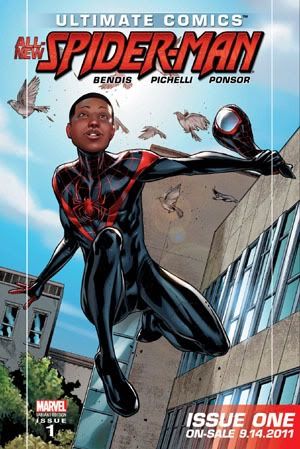
ULTIMATE SPIDER-MAN #1 (New) Reviewed

ULTIMATE SPIDER-MAN #1
Writer: Brian Michael Bendis
Artist: Sara Pichelli
Publisher: Marvel Comics


“We had to fight.  Boys shouldn't have to fight the way we had to.  You shouldn't have to see half the stuff we did.  You—you learn. You study. And you make the world the way you want it to be, not the way it is.” -- Uncle Aaron

The media blitz over the “New” Spider-Man was something that caught my attention and made me interested in trying out this series.  The thing about “reboots” and “alternate worlds” that appeals to me is that the conceptual rules should be able to be thrown out the window.  When the Ultimate Comics line was first announced, I didn't like it because with the SPIDER-MAN book that kicked it off, there was not much changed in any substantive way as far as I could tell.  In other words, from my point of view, it became a pointless appendage to the other SPIDER-MAN titles.  If Peter Parker is essentially going to be the same person he is in the regular Marvel titles except that he's a little younger, I don't see the justification for the ULTIMATE SPIDER-MAN comic book.  At least when THE ULTIMATES #1 was published, I began to get a better sense of Marvel accomplishing what they claimed to be doing with the Ultimate line of titles.  But ULTIMATE SPIDER-MAN's appeal continued to elude me throughout the years.   It took them 10 years to get to a point with the ULTIMATE SPIDER-MAN title to pique my interest and that was the death of Peter Parker and now the relaunch of the title with a new youngster, Miles Morales, taking up the mantle of Spider-Man in the Ultimate Universe.

Finally, they are taking the bull by the balls and doing something that takes full advantage of the freedom inherent in an “alternate” universe and I am here to read it and fully expecting to enjoy it.

I've read it. Now, let's talk about it for a little bit.

Right off the bat, let me state, Brian Bendis is clearly a talented writer and Sara Pichelli is a good artist and visual storyteller. However, I just have to say I can not seem to muster any appreciation for the way that Bendis structures and paces his stories. I've noted it before with other comics, but I find every Bendis comic I've read to be a ponderous chore to sit through. So, as a general rule, I tend to avoid them. Here, though, I was hoping that there would be an enthusiasm on his part in introducing his new character to the world that would be infectious and pull me in. There are some positive things about the comic, but overall I was underwhelmed and disappointed.
The basic gist of what happens, for those who want the spoilers, is the cover showcases the “new” Spider-Man costume.  You open the comic to a scene from 11 months ago to show how genetically modified spider #42 got loose from its box in Norman Osborn's laboratory.  Jump to current day and, someone I assume from his costume to be, the “Ultimate” Prowler is breaking into a vault at the abandoned Osborn lab to steal money and valuables when spider #42 hitches a ride in his bag.  Jump to Brooklyn and meet middle school student, Miles Morales, who is waiting with his parents to see if his lottery number, 42 (naturally), gets pulled granting him entry into a fancy, schmancy charter school.  I'll let you just take a guess about whether his number got pulled.  Miles heads over to his ne'er-do-well Uncle Aaron's apartment to hang out.  Aaron is apparently also the “Ultimate” Prowler and Miles goes snooping through his goody bag and gets bitten by spider #42, has a seizure, and passes out.  Miles' dad comes over and lays in to Aaron, blaming him for whatever just happened to his son.  Miles runs out of the apartment and then finds himself on the last pages standing outside but his body is, sort of, camouflaging itself against the concrete and graffiti and he looks at himself and says “Whoa.” 

To be continued...

That's it in a nutshell.  It ends rather abruptly.  Almost like you're watching a tv-show or movie and the power goes out right in the middle of it.  It didn't make any structural sense to end it like that and made me immediately go back and count the number of pages because I thought I must have missed something.  Nope.  20 pages of story at $3.99 and cut it off right in the middle of the story.  Now I understand why they wrapped the comic in plastic – so nobody could thumb through it and, y'know, know what they were buying. The rest of the comic was a 9/11 reprint.

That was a burn that makes it highly unlikely I will be picking up the next issue because not enough happened in this comic to make me actually give a damn about Miles Morales.  In AMAZING FANTASY #15, Stan Lee and Steve Ditko pulled in the reader in 11 pages and made them care enough about Peter Parker to justify spinning the character off into his own title and now he is one of the most famous fictional characters in history.  At the laborious Bendis-pace, there's no telling when we might come to care about Miles.

The art by Pichelli, is good for what it is.  Unfortunately, it's that dull, static, storyboard-style storytelling that Bendis seems to demand of his artists and I think this artist has the ability and the talent to really take this story up a notch in terms of drama and excitement if she wasn't so bound by these thick black rectangular borders that are restraining the action.

I'm not hating on it in general.  Conceptually, I think the idea of a poor brilliant Brooklyn kid with an uncle who's a thief with a heart of gold, is a good foundation for building a new twist on the Spider-Man legend.  I didn't care for how it unfolded.  I also thought the manner in which the spider escaped and got to Miles in the first place was especially hackneyed.  I would've liked to have seen some better connection to Peter Parker than an Osborn spider that just happened to sneak out of a box because a scientist was distracted.  I was imagining something more along the lines of a kid a bit older than Miles in this comic perhaps hacking his way into an online folder where Parker had kept an encrypted file with details about his biological transformation, blood details, formula for webbing, etc.  Then watch this kid get to work and break the encryption and yada yada yada, driven by some plot device (family in danger, or something like that) to subject himself to, oh, maybe an untested spider-serum or something.

No such luck.  Instead we get what we got.  Maybe it all reads better in the final trade collection, but as a first issue of an ongoing series it was a nice-looking package but wafer-thin on content and a truncated story.   Definitely not worth $3.99 by any stretch, even with Bendis's HITCHHIKER gag use of the number 42 – the answer to the “Ultimate Question of Life.”  Ha.......ha.

Look for this and other reviews tomorrow @AICN Comics!

Tuesday, August 30, 2011

Don't Bother With the New JUSTICE LEAGUE. COMICS REVIEWS FOR THIS WEEK.

JUSTICE LEAGUE #1
Writer: Geoff Johns
Artists: Jim Lee (pencils) & Scott Williams (inks)
Publisher: DC Comics


***CAUTION: SPOILERS ABOUND***

Hold on a second...you're not just some guy in a bat costume are you? Are you freaking kidding me?!” – Green Lantern to Batman.

Well, as expected, I am clearly not the audience that this comic book is intended for. I really tried to just enjoy it on it's own merits, but it's such a lousy piece of work, I find it impossible to generate any sense of enthusiasm for it or for anything else on the horizon of the DC overhaul. I hesitate to call it a “reboot” or a “relaunch” anymore since nobody on staff there seems to be able to consistently define what exactly they are doing other than marketing it in contradictory ways.

This is the first issue of the JUSTICE LEAGUE. It is also the first issue of the “New” DC. DC 3.0 if you will. (DC 1.0 being everything up to CRISIS and DC 2.0 being everything post-CRISIS up to post-FLASHPOINT.) It is also one of the most stilted, disjointed inconsistent messes I've read from DC this side of FINAL CRISIS. The story, as it is, starts in Gotham City with Batman chasing after a monster (who looks somewhat like Sleez from John Byrne's ACTION COMICS days) who turns out to be some sort of minion of Darkseid and blows himself up for no real obvious reason. Well, I take that back. The reason is he is the plot complication that draws Green Lantern to Gotham so he can meet Batman. See, GL is the protector of this space sector and got tipped that an “extraterrestrial” threat had appeared in Gotham. So, he flew straight away to check it out.

Yeehaw! Green Lantern? Meet Batman. Batman? Meet Green Lantern. Much awkward exposition and insipid back-and-forths between the two of them. Apparently, in DC 3.0, GL is (or was 5 years ago, when this was set) is a moron and talks way too much. I had high hopes that in DC 3.0, maybe Batman wouldn't be an asshole. I was wrong. Batman 3.0 is a vigilante who works outside the law and there's a monster running across the rooftops, so understandably the Gotham City Police Department is chasing after both of them. Which is their job!! But that doesn't dissuade asshole-Batman from calling them “idiots”....for FRIGGIN' DOING THEIR JOB!!!!

Yes. Moron Green Lantern just said "It
combusted into fire." Next he's going to
tell us that an ice cube "Melted into
water" or that the water "Evaporated
into gas" or "Froze into ice."
The two of them, Batman and GL, make the brilliant deduction that since the suicide bomber was an extraterrestrial, then they should team up, hold on to the Mother Box left behind, and head to Metropolis to talk to that “Superman” guy that “they say” is an.......”alien.” Which also makes me wonder, looking at these pages again, just exactly how Batman realizes that the Mother Box is not a “bomb” but more like an alien computer. How much experience does this Batman have with alien technology? They just watched “Sleez” blow himself up, why wouldn't they be more cautious with that thing?

Interlude with Vic Stone. These pages of the football game and the spectators in the stands are the stiffest and most lackluster pages in the book. This is when this title could have really benefited from someone who has a stronger ability to move back and forth between action and personal/emotional moments.
The "Victor Stone" I recognize.

On into Metropolis where moron GL instantaneously gets his ass kicked by a red and blue blur. Last panel is our first “exciting” view of Superman 3.0.

This comic has a lot riding on it. Essentially, it sets the tone and spirit of the v-notched-high-collared DC 3.0. The world I found myself in was younger for sure, but it wasn't much different in tone or spirit than DC up till now. I found myself surprised that this was written by Geoff Johns. It didn't feel like Johns to me. The dialogue was terrible and the manner in which it unfolded just did not flow naturally or organically to me. It felt like it was cribbed off a flow chart of plot and character bits. I got no sense of passion or thrill. The interaction between GL and Batman was terrible. GL delivers exposition out the wah-zoo and comes off stupider than Ryan Reynolds' version of Hal Jordan. Batman just groused his way through the scenery with his grouchy, stubbly chin. This sense of each of these characters (GL, Bats, Supes) approaching each other like they're comparing genital-sizes rang false and immature. These are our heroes now. Are they supposed to be 14 years old? They seem to talk at each other like they are. The retelling of Vic Stone's pre-Cyborg life was dull and uninteresting. Whereas, in the original NEW TEEN TITANS series, the character of Vic Stone and his family dynamic was one of those elements that endeared him to me. In this comic, I didn't recognize him as the Victor Stone I once knew. It was just a generic “troubled” character.

I think Geoff Johns was attempting to swipe from SEVEN SAMURAI/MAGNIFICENT SEVEN to create a classic story of how 7 disparate characters could all get drawn together against a common enemy. However, with the use of Darkseid as an other-worldly “god” who winds up drawing our characters together, he actually absent-mindlessly just cribbed from Marvel's AVENGERS for the JUSTICE LEAGUE version 3.0 with Darkseid filling in for the Loki role.

I was really hoping for something more substantial and truly new in approach. This was, unfortunately, just the TACO BELL JUSTICE LEAGUE, where they look at the ingredients they already have on hand, mix them up and rearrange them, and claim an “all-new” menu. But it's really just the same old tacos and burritos.

Artistically, I found the comic to be mostly sketchwork-level with massively overdone coloring work. Much of the action was hard to follow. The flow of the work from panel to panel was inconsistent and was at times distracting. The details on Batman's annoying armored costume come and go from panel to panel. GL has irrelevant seams and/or armor on his chest and arms that makes no sense with the rest of the costume where the boots and gloves look like cloth. Either go organic like the recent film, or cloth like in 1.0 and 2.0, or go construct-armor style. The inconsistent blend of the two is distracting. Superman looks like Ultra-Man now.

I've seen some of Jim Lee's pencils, which were stronger than the stiffness and sketchiness here, so I may have to lay blame on Scott Williams' inking for some of my disappointment. The color work made some panels not only difficult to distinguish what was happening, but just plain hurt my eyes. I'm not sure why some modern colorists don't realize that just because you CAN do photoshop effects doesn't mean you HAVE to do them. In fact, that last page reveal of Superman is an example of terrible texturing and effects unnecessarily intruding on what should be the most exciting panel in the book.

I was honestly planning on getting the trade for this book because I usually like Geoff Johns's writing and Jim Lee's art. But now, I think I'll just move on to something else.

Reading this comic reminded me of a line from The Who when they sang “Meet the new boss/Same as the old boss.” And remember the title of the song? I hereby nominate “We Won't Get Fooled Again” as the theme song for the DC Comics fans.


FLASH GORDON: INVASION OF THE RED SWORD PART 4: POWER
Writer: Brendan Deneen
Artist: Eduardo Garcia
FLASH GORDON?!” – King Crax of the Fire People
Uh..yep, that's me. Unless you want to kill Flash Gordon. In which case, I hate that guy too.” – Flash Gordon
In a week in which one major publisher hits blitzes the comic shops with their insanely over-hyped relaunch, there's a slight...ever so miniscule....chance that some lesser hyped comics might get overlooked. In this case, one that might get overlooked might be Ardden Entertainments current FLASH GORDON series. So, let me take a moment to remind you that this comic is also available today at your local comics retailer.
I hear a lot of grousing (and sometimes do the grousing myself) about the absence of fun and adventure in modern comics. I keep looking forward to this series every month precisely because it fills that void. It is possible to tell a serialized adventure series in comics without on panel rapes, graphic beheadings and amputations. It is possible to entertain the hell out of your reader without rotting corpses and psychopathic over-the-top villains. It is possible to tell a long-form story in serialized form that is complete on its own yet continues the larger story and it is possible to do proper character development without crossovers and tie-ins. FLASH GORDON demonstrates this every month, consistently.

As it should, this comic moves from cliffhanger to cliffhanger each month and is a thrilling ride every time. The invasion of the planet Mongo by the bloodthirsty humans of The Red Sword is in full force right now and our heroes (and villain) are separated and struggling to survive. As the anticipation builds in the story, so does the anticipation in the reader as to if and when our team will reunite and quell this invasion. More importantly, how can they rebuff the Red Sword without reestablishing Ming as the powerful Emperor of Mongo.

The difficult thing is to write about an issue like this without overly spoiling it, but at the end of the previous issue, Flash found himself abandoned by his “partner” Ming (no surprise there) to drown in a flooding cave. Since the comic is eponymously titled, it should come as no surprise that Flash figures a way out of his predicament, but then he finds himself once-again face-to-face with a fire-breathing dragon. This creatures seem to be rather common on Mongo.

Dale Ardden, Vultan, and his daughter Talon meet a race of men I, at least, am unfamiliar with – The Power Men of Mongo. Another fascinating extrapolation of beings in that The Power Men are cyborgs on the run from the brutal rule of Ming. Threads of story are picked up from the FG: MERCY WARS and Queen Fria of Frigia.

In other words, a whole lot happens in this one comic book. And this has been the pattern for the entire series. This is seriously one of the best paced books out there, as are all the Arrden and Atlas comics, in that it mirrors the active storytelling of the old movie serials but actually involves the reader in the lives and the personalities of the people of Earth who are stranded on Mongo, but especially those who are native to Mongo.

Ming is missing from this issue, but his presence is like an umbrella covering the entire proceeding. The series is called FLASH GORDON, but Ming is the character who keeps it focused at all times.
 
Every time I review this series, I always make a point of complimenting the art. The thing about the artist, Eduardo Garcia, is that he came on to this series following an artist who had already established the look and the style for it. That's a tough place to find yourself in as an artist. What I have noticed from issue to issue is that each successive issue begins to look less like Garcia is trying to match that earlier style and more organically Garcia himself. And that's a progression that I whole-heartedly approve of. I enjoy his work and he's a fantastic graphic storyteller. I also will take a moment to rave about the color work once again. It always strikes me how other-worldly Mongo seems. It really looks like the reader is viewing these scenes through the light of a sun and planet quite different from our own. And these color and lighting choices are deliberate and effective. If you're already reading this series then you know what I'm talking about. If you haven't picked it up yet, this is a good time to jump in because you can get all four issues and be up to speed before the next one comes out.

AND DON'T FORGET TO CHECK OUT THESE AND OTHER COMICS/GRAPHIC NOVEL REVIEWS AT AINTITCOOL.COM

They are a great bunch of guys who really tell it they way they feel it,
and that's hard to come by in the comics reviewing market.