Tuesday, November 22, 2022

BOOK REVIEW: THE PERFECT ASSASSIN by James Patterson & Brian Sitts


THE PERFECT ASSASSIN

(A DOC SAVAGE THRILLER)

By James Patterson and Brian Sitts

Available November 2022 from all major booksellers

    I opened the door. An automatic sensor turned on a bank of industrial lights overhead. As my eyes adjusted, I suddenly felt totally sober again. I couldn’t believe what I was looking at.
    We were in a huge room with a high ceiling and no windows. It was filled with metal shelves in long, neat rows. It looked like a natural history archive. It had the smell of old paper, old chemicals, old leather.
    “Welcome home, Doctor.” said Kira. 

Anyone who has ever engaged with me in a discussion about books and writing should already have a sense that I have a real problem with ghost-written books—that is, I do not like writers who take credit for someone else’s work even though I know it is a long-standing practice in the industry. I still don’t like it. Under that umbrella, I also do not like it when certain authors—in this case James Patterson—turn their names into a book factory in which other writers actually write the books but Patterson gets his name in 4-inch letters plastered across the cover of the books while the actual author’s name appears as an after-thought. In this case, Brian Sitts, the author (as in, the one who actually wrote the words that are published and not the outline on which the story is based), has his name buried at the bottom of the cover and at such a low-level transparency that it effectively disappears.

And considering that this is a “Doc Savage” novel, I am sure that someone reading this is wondering whether I have the same problem with other Doc Savage novels given that no matter who wrote them they all were, with one notable exception, credited to the house-name “Kenneth Robeson.” My answer would be no. I do not have the same problem with house-names because that particular industry tradition is one where the named author is something of a character himself (or herself in the case of female house names such as “Carolyn Keene” from the Nancy Drew series). Lester Dent was the most prolific “Kenneth Robeson” in the heyday of Doc Savage pulp adventures and Will Murray the most recent. The notable exception that I mention above in which Doc Savage was published previously with an author credit to someone other than Kenneth Robeson was the classic ESCAPE FROM LOKI by Philip José Farmer which detailed the story of how Doc and his five colleagues first got together. And now fast forward to the year 2022 and THE PERFECT ASSASSIN, credited to “James Patterson” as primary author and Brian Sitts as secondary, with the series tag “A Doc Savage Thriller.”

Even given my general misgivings about how the James Patterson machine works, I approached this book with an open mind. I was curious how it would tie into the original Doc Savage books (if at all) and whether it would outright betray the core principles in terms of character and morality that those pot-boiler pulp action stories trafficked in. Would Sitts try to duplicate the Robeson entertaining action prose style or would it embrace the choppy simplistic Patterson style? Would I be engaged with the new characters or long for the originals? Would it be interesting? Would it be entertaining? Would it be infuriating? 

Well, it’s not infuriating.  It’s somewhat interesting.  I was moderately entertained.  The characters were not as engaging as they could potentially become.

As I said, I had an open mind but I still had some hesitancy given that the previous Patterson/Sitts effort to do this with Doc Savage’s sister property, THE SHADOW, had by all accounts gone off into crazy-land and taken The Shadow character and pulled a “Jonah Hex” on him by abruptly transplanting him into the future which placed the original character in a setting that did not work at all for him. However, I felt a bit more positive about this one because rather than using Doc Savage (Clark Savage Jr.) himself, this story is set in the modern day and centers around Doc’s great-grandson, Doctor Brandt Savage. This is easier for me to walk into with a readiness to accept given that he is, for all intents and purposes, an all-new character. The idea opens itself up with potential to do something new and moving the concept forward rather than trapped forever in the pre-World War II era. As I am fond of pointing out, if you aren’t moving then you’re stagnating. And it is the same with fictional characters. There’s a risk of stagnation if your characters stay stuck in the past, never-changing, never-growing, forever. If the concept and characters are strong enough, they should be adaptable to a diverse range of changes and growth and sometimes you don’t know until you try and either fail or succeed.

Oddly, there is little in terms of discernible style to the Sitts prose. I think the longest chapter is four pages. Some chapters are as small as half a page. It’s an odd style of writing. I know it’s common with these modern popular thrillers but it feels choppy and awkward to me. There’s so little opportunity for the reader to engage with the characters and be in the moment; to enjoy the prose. It feels like it could almost be written by an A.I. as there is an utter loss of an author’s perspective or voice in the writing. The original pulp adventures were churned out every month and yet they somehow had a style to them that makes them still enjoyable to read even today, if not for the stories, then for the enjoyment of the prose itself. The robotic construction in the writing for THE PERFECT ASSASSIN is such that it almost feels like an extended outline of a story rather than a complete novel. In fact, I suspect that if it had been formatted more traditionally, those 108 chapters and 316 pages, would have come in closer to around 200 pages and about half that number of chapters.

All that being said, I stuck with the plot, such as it is, which is pretty standard Patterson fare about a regular someone getting pulled into danger and intrigue by a mysterious someone else. The authors introduce the reader to 2 main characters, Brandt Savage (of course) and his co-star, and catalyst for this story, is a bronze-haired female calling herself “Meed.” Her story covers similar ground as what Marvel has done with their Black Widow character in the films. But that’s not something to be too critical about as the idea of a female character raised to be an assassin in a training school for assassins is not unique to Marvel either. Unfortunately, Meed is consistently the more interesting character than Brandt, which is unfortunate for a book that is supposed to be jump-starting a new series of “thrillers” starring this new Doc Savage. He seemed weak, as a person (not his body) and I was trying to figure out why I had this impression.  I finally realized the reason—and in a way I think this may be the key to how this version of the character could potentially grow into something good if successful enough in sales to continue—Sitts does something with Brandt that I don’t think was ever done with his great-grandfather in the writing.

Whenever the narrative shifts to a chapter about Brandt, the perspective shifts to first-person. So we are inside Brandt’s head. We hear his fears, his anxieties, his nervousness, his insecurities. Why does this matter? I think it matters because for readers of the original Doc Savage stories, Doc’s inner thoughts are a mystery for the most part. He was a man of action. Sure, he was obviously a genius, because the reader was told this, and the number of inventions he created along with his multiple doctorates and surgeon skills establish his bona fides. But we never got inside his head much to see what inner demons he was battling. Farmer tackled some of that with his Doc Savage pastiche, Doc Caliban. While the Caliban stories could reflect the prose style at times, there was still a Farmerian filter that deconstructed the implications of such a character. In Brandt, we have a young professor who is somewhat embarrassed of his connection to the legendary Doc Savage to such an extent that he has contemplated changing his last name. But as that is the name on his diplomas, he’s content to just let it lie. This little tidbit is a key to the struggles Brandt is going to need to overcome to ever fully embrace his role as the inheritor of the Doc Savage mantle. He is a character with the genetics necessary to be a hero, but none of the desire or the motivation to do it. Meed functions as the catalyst for his journey to becoming a hero and she has her own lineage connection to the past that is a conduit for her and Brandt to forge an unbeatable team. This is not a story about a carbon copy of the original Doc and his amazing five assistants. They were a product of their day. This is a flawed and reluctant Doc and his single partner who has her own hidden motives for why she needs to push him into accepting his destiny. 

I was pleased to see that the Patterson machine did not undo the past or do an “everything you know is a lie” approach. No. Everything you knew is true, mostly, although there are some new wrinkles introduced and established connections with Doc Savage history is interwoven throughout. He smartly avoids filling in the gaps of what happened to the original Doc Savage and even maintains a noticeable vagueness about Brandt’s unnamed parents and who they are. He is aware of his famous great-grandfather, but has not ever known him, so his journey of self-discovery is also learning about his great-grandfather. There is no betrayal of the original character and concept but there is most definitely a major change introduced to it. The most intriguing to me involves the importance of “twins” in the very concept of genetically engineering the perfect human. I feel like Sitts or Patterson (or maybe both) has read Farmer’s Doc Caliban, but I can’t prove it. However, the twins idea, name-checks, and the new twists we learn about Doc and his lineage are surprising enough to bring me back to see how that is developed in future installments. 

My overall impression of THE PERFECT ASSASSIN is that it could have been more creatively skilled with its prose style and achieved its goals better. The end products winds up as a perfectly middling exercise and unlikely to garner new fans of Doc Savage but also unlikely to please current Doc Savage fans. However, even with the exceedingly simplistic writing style and choppy construction, I enjoyed it well enough and it ended strong with the new Doc Savage ready to start on a new adventure and I would like to read more about him. 


Sunday, January 30, 2022

COMICS REVIEWS: HEROES UNION #1, BLUE BARON #1, BIG BANG ADVENTURES #14—THE LAST WHIZ KIDS STORY PT 1


Writer & Bookrunner Darin Henry

This column's reviews, although I hesitate to call them "reviews" simply because it is bit more gonzo than that, are going to hearken back to classic Bronze Age comics from Marvel and DC—I would say....circa early '80s.  The first column focused on the latest comic from Big Bang Comics, featuring the Knights of Justice, and I will be covering the newest Big Bang comic in this as well.  But before I get to that, there is a new upstart in the battle of the independent retro-comic book publishers.  I'm speaking of a new little company calling itself Sitcomics™ with the tagline: "It's TV you read!" Sitcomics is the brainchild of veteran sitcom writer Darin Henry and these are not "comic" books, instead they call them Binge Books™.

Binge Book™ Back Cover Numbers
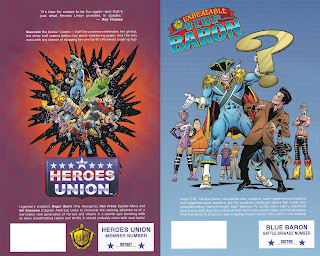
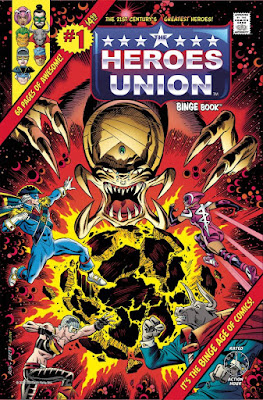
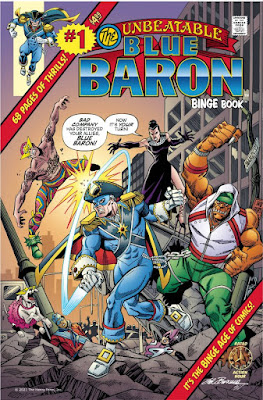
The Binge Book format seems to be conceived to appeal to modern binging sensibilities but also the aging generation who does not feel particularly good about the digitalization of comic books and wants something physical in their hands to read.  A Binge Book is printed, first of all.  The books are not made available, legally, in a digital format outside of the occasional free preview download (such as BLUE BARON #3 which you can preview digitally here).  This is an enormous 68 pages perfect-bound comic with glossy card stock covers and, notably, include a unique number on the back cover.  THE HEROES UNION give you your own "Member Number" and BLUE BARON gives you your "Battle Brigade Number" respectively.  The availability of these comics is strictly through comic book stores. They are not print-on-demand or available direct from the publisher.  These are legit limited print run comics that are specifically targeted to comic book readers through local comic book shops.  Whether this will, over time, enhance their collectibility I can't say.  But it does mean that you will have to let your local comic book shop know you're interested so they can stock it or you will need to order from a comic shop who lets you order online and be willing to pay shipping costs to get your hands on it.  Depending on your thirst for brand new old-school super-hero comics with some writing and art by old-school comics creators, you can choose your method.  Feeding into that old-school nostalgia, you will also note the cover designs that are busier action images, as opposed to the more modern pin-up style cover approach, along with top-left corner images and even an "Approved by the Comics Code Authority" stamp (which is pure nostalgia given that the CCA does not even exist to grant or decline the stamp anymore).

Overall, if that's your jam, I highly recommend seeking out some of Sitcomics' Binge Books.  For now, here's a few words about the two I made the effort to try out for you.

THE HEROES UNION #1

Writers: Roger Stern (script/co-plotter) & Darin Henry (co-plotter)
Artists: Ron Frenz (penciller)/Sal Buscema & Chris Nye (inkers)/Glenn Whitmore (colors)

Publisher: Sitcomics

What better way to evoke early 80s Marvel Comics than to bring on one of best Marvel writers of that time period, the esteemed Roger Stern, to co-plot and script this first outing of The Heroes Union?  Well, you could pair Stern with artists Ron Frenz and Sal Buscema, both Marvel stalwarts from that same time period, is that the best you can do?  Apparently not, because Sitcomics also brought on longtime digital colorist Glenn Whitmore to give the whole thing a classic color vibe and Marvel and DC veteran inker Brett Breeding to ink Frenz on the cover.

That's pretty damn good. 

There's a lot to set up in this single issue, but thankfully, there's 68 pages so there's plenty of breathing room to pace the story accordingly.  Stern helps set up the Binge Universe (which is as good a name as I could come up with in the moment) by giving us hints and glimpses of a history here that can unfold over time in other stories and other titles, but for now he establishes for the reader what we need to know: Who, or What, Is The Heroes Union?  Clearly the Union is the Binge U's version of The Avengers.  Uniquely, while the characters who make up this newest incarnation of the Union legacy team may track with certain common tropes, none of them smack of being pure pastiche or homage to a specific Marvel character.  I think that is a great benefit to the comic and to the line of comics itself that they are carving out their own world of characters within a certain "style" of art and writing without copying or homaging specific characters or stories.

The story and art are well-done and consistent with the 80's feel they are going for but within a 21st century milieu.  That means there is a certain level of acceptable naivete in this world in which super-heroes exist, but without a need to examine the absurdity of that concept or a need to overcompensate by approaching it in a hyper-realistic fashion.  This is old-school comics, including the nearly non-existent these days, "thought balloons" that give us insight into characters' thoughts without the need for endless exposition in dialogue or caption.  I'm not saying it needs to be in every panel of a comic, but it is a tool that needs to be returned to the modern comic book writer's toolbox and Stern knows how to wield it.

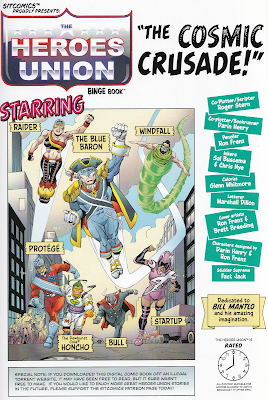
In classic first issue fashion, the story begins with a young/new hero, for this one it is the character calling herself Startup, receiving the invitation to join a team.  So, her journey of discovery is the reader's journey as well.  It is a solid way to introduce the concept and the characters (see the inset image which is a splash page type image included on the inside cover as a sort-of roll call of the team members).  Very quickly, the action kicks in and the reader gets aliens, space ships, other planets, lots of action and intrigue.  Basically, its everything you wanted to get back in the day when you were buying comics like this off a spinner rack for 50 cents.  But maybe a bit better given the better quality of printing and paper stock and the freedom of creating their own continuity rather than writing within a larger continuity.  The last couple of pages provide the reader with a Who's Who type glossary of the characters for handy dandy reference and it looks like the space is intended going forward as a Letters Page/Binge Bulletins space. All I know is that it was fun to read and I think it's worth checking out. 

Which brings us to the comic book teased at the end of THE HEROES UNION #1 . . .

THE UNBEATABLE BLUE BARON #1

Writer: Darin Henry
Artists: Ron Frenz (penciller)/Sal Buscema (inker)/Glenn Whitmore (colors)

Publisher: Sitcomics

My second outing with a Binge Book was Blue Baron.  In brief, Blue Baron is pretty much a mashup of every patriotic super-hero with The Phantom in that Blue Baron appears to be immortal but he's really a generational identity passed down for 300 years from father to son to grandson.  For this one, creator Darin Henry takes on the full writing duties and demonstrates that his experience writing for television translates well to the comic book medium.  He is joined ably by 80s Marvel vets, Ron Frenz as penciller and Sal Buscema on inks.  So, visually, this comic looks like a classic Bronze Age Marvel book in all ways except that the characters are all-new.

This issue revolves around a common comedy trope in movies, tv, and yes, in comics.  But I have to say, I was pleasantly surprised by how it avoided a cliched resolution but rather uses it as a way to kick-off the series with a completely different status quo than expected.  Other than that, the comic is just a good rollicking adventure with lots of clever moments.  Highly recommended.


Friday, November 5, 2021

Marvel's ETERNALS Movie Review *Spoiler Free*


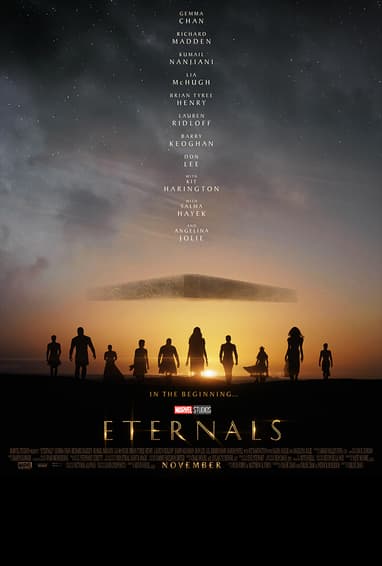
Marvel Studios' Eternals Movie Poster

 ETERNALS

Director:  Chloé Zhao
Studio:  Marvel Studios
Release Date: November 5, 2021
Rating:  PG-13: fantasy violence and action, some language and brief sexuality.

Official Website: https://www.marvel.com/movies/eternals

Following the events of AVENGERS: ENDGAME (2019), an unexpected tragedy forces the Eternals, ancient aliens who have been living on Earth in secret for thousands of years, out of the shadows to reunite against mankind's most ancient enemy, the Deviants.

Review: "Based on the Marvel Comics by Jack Kirby"

It's been a long time coming to get that singular attribution on an MCU film! That gave me the feels when the credits rolled.

As the first 45 minutes of exposition and wooden acting plodded along, I thought the critics might be right in their negative reviews.  But then....our first scene in the modern day with Kumail Nanjiani as Kingo happens.  And from here on out, the film picks up speed and moves forward.  It felt almost like that's where the movie itself actually starts and the first 45 minutes was just prologue or something.  Which maybe explains the 2 hours and 37 minute runtime.

One of the first things people mentioned coming out of the previews was that ETERNALS is unlike any other MCU movie and the marketing has claimed ETERNALS changes the MCU forever.
Both are correct.


In fact, it not only doesn't feel like any Marvel movie so far, it actually feels very much like Marvel Studios doing their own version of DC's Justice League.  For those who've complained about Henry Cavill's dour version of Superman, Richard Madden as Ikaris (the Superman analogue here) makes Cavill's Superman seem downright cheery and bubbly.  Angelina Jolie as Thena (the Wonder Woman analogue) is an extremely necessary jolt of star power that helps balance the others who don't quite have her level of screen charisma. 

The actual comics history and purpose of The Eternals is substantively changed to fit within the MCU paramaters and for the most part, I think it works quite well.  In the end, not only does The Eternals add to the history of Earth in the MCU, it makes a dramatic change to the landscape that is about on par with the "blip" and Loki's introduction of timeline variations and multiversal implications.  I'm sure these will be plot points referenced in other films and shows going forward.  Not the least of which is the future of Dane Whitman and his family's legacy.

On the cosmic level of the MCU, The Eternals has reset the power structure on the space/time chess board and I'm intrigued by the vast possibilities of where this story can go in the future.  
The mid-credits sequence is the most "Marvel" moment of the entire film, and it will also elicit fanboy squeals of delight by old school Marvel kids from the 70s and 80s who are now grumpy too-old-for-comics fans. 😃  The after-credits sequence is an excellent and intriguing after dinner dessert tease.

I enjoyed it immensely.  For a longtime Kirby Eternals fan, I was suprised by so many thematic and conceptual elements that were retained but also suprised by the new ideas and expansions logically brought into the mix.  A few head-scratchers in terms of wondering why some particular choices were made (such as no Zuras at all and Ikaris's hair color change) but taken as a whole, it all pretty much worked for me.