

Showing posts with label Comics. Show all posts
Showing posts with label Comics. Show all posts
Saturday, October 3, 2015
TYPOLOGY COMICS PRESENTS: ESTP AND INFP COMICS
Recently Stephen Colbert featured the MBTI Personality Assessment on his new Late Show. It triggered in me an idea to do a series of MBTI-oriented comic book cover parodies and this is my first foray into this series of Photoshop wonders: THE ESTP AND THE INFP, which is perfectly encapsulated in Steve Ditko's super-hero brothers The Hawk (ESTP) and the Dove (INFP). Enjoy.


Sunday, April 19, 2015
Thursday, December 12, 2013
ROOKIE OF THE YEAR! Interview with Tavi Gevinson of RookieMag.com

The book itself is an impressive production and Tavi herself may simply be the most accomplished 17 year-old I’ve ever met. I’m retroactively embarrassed by my slothful 17 year-old self now.
Keith Howell (Me): Nice to meet you, Tavi.

Me: Well, I've read through your ROOKIEMAG YEARBOOK VOL. 2. I shared one of the articles with my 16 yr old homeschooled daughter and then posted it on my FB page.
The "No More Nice Girls" article.
Tavi: Oh, that makes me so happy! I hope she liked it. “No More Nice Girl” is one of my favorites. That writer, Sady Doyle, is so talented.
Me: It was exceptionally sharp. Well-written.
I appreciated her perspective.
The whole endeavor, the website and book are damned impressive work. I hope you realize that. :)
Tavi: Thank you so much.
 We all work really hard on it, it's a labor of love for sure, so this period of time when we have events and signings and can see Rookie live offline is extremely rewarding.
Me: In this day and age, where publishers are going to the web more and more, what was it within you that got you thinking along the lines of doing it reversed — taking it from the web to the printed age and doing it so creatively?
Are you a tactile learner?
Tavi: I don't know if I'm a tactile learner so much as I'm just impatient. I knew how I wanted the series to look when we started talking about doing the first one, and figured I would learn the technicalities of the process along the way.
Me: Are you the type who just says "I want it to be like this." and expect someone to just figure out how to get that done or are you more...fluid about it. Like maybe have a generalized concept and feel it out as you go?
Tavi: My way of operating with Rookie has never been to just say "I want it this way" and let people fill in the blanks. There's always a conversation going on, any kind of disagreement never feels personal: we're all just here to make the strongest work we can for our readers.

So I knew our readers would like to have a version of Rookie they could hold in their hands, experience in a more visual way, keep on a nightstand. For this reason, it was also important to make it worth it -- not to do a copy-and-paste website-to-book.
Every spread was exhaustively decorated and thought through.
Me: Yes it is. It's not just a reading book, it is interactive. It's informative and interesting, but also fun.
I would also imagine that your schedule is just jam-packed most days. Do you still find time for purely pleasure reading?
 Tavi: It's nice of course when a book we read for English is also pleasurable to me. I try to make time for both but usually I can only stick with what I have assigned for school.
Me: Understandable.
What stories out there inspire you? (film, comics, books, whatever).
Do you find inspiration in stories?
Do you have a favorite poet, for instance?
Tavi: Yes, absolutely -- even though Rookie is not the same as, you know, making a fantastical movie or something, even though it's not fiction and we are trying to be honest, I feel most inspired after reading a book or watching a movie. I think it's because they create a feeling in you that makes YOU want to do the same, and that's important to us at Rookie, inspiring our readers to be creative themselves, instead of just taking in what we do.
I love Patti Smith and E. E. Cummings and Margaret Atwood.

Most of my favorite movies are teen movies, dark comedies like HEATHERS
Me: HEATHERS is amazing! I was there when it first came out!
How do you take it knowing that there are people (many of whom you've never met) who are inspired by you?
Is that humbling or energizing?
Tavi: I know I can't read into it too much -- I gave a talk about “fangirling” at the Sydney Opera House and Melbourne Writers Festival in August about this -- because so much of what people love about a writer, musician, etc. is more a reflection of the person who loves it. So I'm very happy people respond to what I do or can see me as "inspiring," as you say, but I know there's a lot that goes on between my putting myself out into the world and how they receive me. I also just think it's unhealthy to take any feedback too personally, whether it's positive or not. It's just tricky territory.
Me: You have a healthy attitude. Very wise.
Tavi: Ultimately, however, you know, I'm not complaining. For as much as there's no for sure way to measure the validity of every single ounce of feedback from every single person, I am pleased and flattered that the overall response to what I do has been encouraging.
Me: What has been the biggest surprise (or surprises) to you about embarking on this endeavor?
Tavi: Hmmm. That it's happened at all, really.

Me: The book itself is kind of crazy and magical. I can't think of anything else out there like it.
Tavi: Thank you so much! That's so nice of you to say.
Also, (another surprise), when I went to Fashion Week regularly and wrote about fashion and worked with fashion magazines, everyone thought that industry would like, poison my brain. Honestly, I think there is that kind of cattiness in a lot of different areas I've worked in. It's not exclusive to fashion, or any industry.
It's just that when stuff like power comes into play, people get insecure or threatened or what have you, and then they forget about what they actually love about their work, and they act out -- whether they work in fashion, publishing, film...The risk in saying this is making myself the exception, and I'm not; I get disillusioned, too.

But if you're asking what the biggest surprises have been, that's one of them: that I have witnessed more cattiness among adults with jobs than I have in high school.
Me: Thank you for chatting with me, Tavi. You've been very gracious. Okay. Take care. I hope we can talk again another time.
Tavi: Yes! Thank you!
*This interview, with slight re-edits, was originally published under my "Prof. Challenger" nom de plume at Aint-it-cool.
Thursday, May 9, 2013
THE STORY OF O Graphic Novel Reviewed
In 2009, I reviewed THE STORY OF O hardcover collection of the late Guido Crepax's comic book adaptation of the Pauline Reage's classic of sado-masochistic eroticism. I just discovered that the out-of-print collection is now available digitally at Comixology. So, I present that link here and reprint my review in full for any who might be curious. The price for the digital is $9.99 or you can download a 10-page preview version for free. Here's the link.
 THE STORY OF O
Writer: Pauline Reage
Artist: Guido Crepax
Publisher: NBM Comics Lit/Eurotica
“O realized that through the medium of her body shared between them…they attained something more mysterious and perhaps more intense than an amorous bond…a union of which the very conception was arduous.”
To review hardcore erotica of the sort like THE STORY OF O is a challenging task, at least for me. It is easy to approach something like this with a flippant adolescent mocking tone. But, as far as I’m concerned, that does a disservice to the artist’s intent in something like this. For those who may be unfamiliar with the story itself, the original prose version of THE STORY OF O was first published in the 1950s and was a shockingly explicit and brutal yet also sensual and erotic examination of sexual submission. The story was so shocking, in fact, that the French government attempted to suppress it. In the most graphic of details, this misogynistic story involves a man’s deliverance of a series of progressively more degrading, painful, and humiliating sexual abuses to his mate. Through these acts of bondage, pain, and shame he breaks her spirit and reduces her to his complete and utter will-less sexual slave….even to the point of having her branded with his initials.
Even in these more “open” times with all forms of pornography available to anyone with access to the internet, the story is still shocking in the extent to which the writer…a woman herself…dove headlong into the deepest parts of the human sexual dark places. It is a dirty thing to read. It is harsh and mean and twisted. After each new level of abuse that O endures, her husband makes her tell him she loves him. If she reaches a point of enjoying the pain or abuse, then the abuse is increased until she breaks again. It is a story of depravity and how such debasement can be twisted into love.
Ultimately, while the original novel itself is a classic of erotic literature because of the times in which it was first published, this graphic adaptation by Guido Crepax is a classic itself even though it was not originally published until the 1970s. Crepax, who passed away in 2003, was an amazing Italian comic artist who tore down barriers in his commitment to using the comic book form to tell truly adult stories. In his attempts to liberate the European world of comic art in the 1960s and 1970s from the emphasis on childish content, he boldly stepped up and tackled sex and pure erotica as his own emphasis. From his own original character Valentina to adapting classics of erotica in graphic form, he established himself as a master of the sexual genre and comic art medium. Crepax’s adaptation of THE STORY OF O is widely considered his magnum opus….and with good reason.
In this review, I’m not going to attempt to give an opinion on the “story” because that would be akin, in my opinion, to reviewing a Classics Illustrated adaptation of…say…A CHRISTMAS CAROL… and actually taking time to talk about Charles Dickens’ efforts in writing the original story. So, I will let the story stand on its own and I’ll let each reader determine his or her own degree of comfortability with it. Instead, let me address what is paramount in this new hardbound complete collection of Crepax’s adaptation…which was originally serialized…and that is Crepax’s efforts here as illustrator of Pauline Reage’s story.

First of all, the Eurotica imprint of NBM Publishing has done a beautiful job of packaging this book together. Crepax’s work is entirely in stark black and white, as befits the story itself, and the book designers have utilized his work in crafting an attractive black cover with a gorgeous small panel of O’s face blindfolded and with a chained collar on her neck. It is perfectly symbolic of the overall theme of the book itself and slyly provocative enough to catch the casual observer’s eye with its placement surrounded by so much blackness…once again the use of black also symbolizing the harsh darkness of the world the reader is about to enter. The subtle and unique circular signature of “Guido Crepax” is also positioned on the cover so that those who know the name also know what they are about to encounter within the pages of this book. The end papers are almost entirely black except for a series of 1” x 1 ½” panels running horizontal from end to end to where they almost look like a series of frames from a film. The panels present O performing graphic sexual acts of submission and guide the reader to turn the page where the next two pages are entirely white except for an ever so subtle profile image of O’s face with her open mouth and extended tongue directing the reader to turn the page and start the story.
Crepax is a master storyteller and he wields a lyrical brush. His style is beautiful with a nouveau tendency towards elongated bodies and necks especially…but not grotesquely so. The smoothness of his brush work just glides across the page in most instances and only in the most intense moments does he allow his work to get rough and scratchy. It usually flows beautifully and sensually…especially in those moments of tenderness usually reserved for moments of woman to woman love-making. When the misogynistic men are raping and abusing O, his work gets harsher and it makes for an interesting contrast in emotional impact.

I found his storytelling in panels to almost be a class in and of itself in how to deliver information to the reader. As graphic as he gets in showing all forms of sex and brutality, what is also fascinating are his artistic choices in what he chooses NOT to show and leave to the reader’s imagination. Such decisions are what make this work so effective from an artistic perspective. This is not a happy work. It is not a joyful work. It is something that should shock the reader’s sense of propriety and what’s right. It should even generate disgust and anger at moments. And yet, the beauty of Crepax’s art somehow makes it palatable and I found it to be something I couldn’t put down…and have gone back to a number of times to look at his approach to presenting progression and movement. Crepax uses minimal line work at times when he wants the reader to feel more sensual and then heavy and harsher linework when he wants the reader to be repulsed and shocked.
He utilizes very little actual dialogue in this adaptation; instead he delivers the narrative primarily through pictures. He takes an approach to the page that never follows the standard comic book panel format but completely shakes it up with utter inconsistency in panel choices. Indicative of the trauma that O is undergoing in her life, the reader is never allowed the reliable precision of the standard 6 panel comic book page. Through it all, however, one thing never changes and is reliable….O is never less than always beautifully sexual. Crepax makes sure that her sexual beauty draws the reader’s eye even when the heart or mind might want to pull away from the events that are unfolding.
Guido Crepax truly was a master storyteller, and while he may have focused his talents in an area that many are afraid to go, if you can handle the content, Crepax’s THE STORY OF O is actually a must-have for those who love graphic storytelling in all its many forms.
THE STORY OF OWriter: Pauline Reage
Artist: Guido Crepax
Publisher: NBM Comics Lit/Eurotica
“O realized that through the medium of her body shared between them…they attained something more mysterious and perhaps more intense than an amorous bond…a union of which the very conception was arduous.”
To review hardcore erotica of the sort like THE STORY OF O is a challenging task, at least for me. It is easy to approach something like this with a flippant adolescent mocking tone. But, as far as I’m concerned, that does a disservice to the artist’s intent in something like this. For those who may be unfamiliar with the story itself, the original prose version of THE STORY OF O was first published in the 1950s and was a shockingly explicit and brutal yet also sensual and erotic examination of sexual submission. The story was so shocking, in fact, that the French government attempted to suppress it. In the most graphic of details, this misogynistic story involves a man’s deliverance of a series of progressively more degrading, painful, and humiliating sexual abuses to his mate. Through these acts of bondage, pain, and shame he breaks her spirit and reduces her to his complete and utter will-less sexual slave….even to the point of having her branded with his initials.
Even in these more “open” times with all forms of pornography available to anyone with access to the internet, the story is still shocking in the extent to which the writer…a woman herself…dove headlong into the deepest parts of the human sexual dark places. It is a dirty thing to read. It is harsh and mean and twisted. After each new level of abuse that O endures, her husband makes her tell him she loves him. If she reaches a point of enjoying the pain or abuse, then the abuse is increased until she breaks again. It is a story of depravity and how such debasement can be twisted into love.
Ultimately, while the original novel itself is a classic of erotic literature because of the times in which it was first published, this graphic adaptation by Guido Crepax is a classic itself even though it was not originally published until the 1970s. Crepax, who passed away in 2003, was an amazing Italian comic artist who tore down barriers in his commitment to using the comic book form to tell truly adult stories. In his attempts to liberate the European world of comic art in the 1960s and 1970s from the emphasis on childish content, he boldly stepped up and tackled sex and pure erotica as his own emphasis. From his own original character Valentina to adapting classics of erotica in graphic form, he established himself as a master of the sexual genre and comic art medium. Crepax’s adaptation of THE STORY OF O is widely considered his magnum opus….and with good reason.
In this review, I’m not going to attempt to give an opinion on the “story” because that would be akin, in my opinion, to reviewing a Classics Illustrated adaptation of…say…A CHRISTMAS CAROL… and actually taking time to talk about Charles Dickens’ efforts in writing the original story. So, I will let the story stand on its own and I’ll let each reader determine his or her own degree of comfortability with it. Instead, let me address what is paramount in this new hardbound complete collection of Crepax’s adaptation…which was originally serialized…and that is Crepax’s efforts here as illustrator of Pauline Reage’s story.
First of all, the Eurotica imprint of NBM Publishing has done a beautiful job of packaging this book together. Crepax’s work is entirely in stark black and white, as befits the story itself, and the book designers have utilized his work in crafting an attractive black cover with a gorgeous small panel of O’s face blindfolded and with a chained collar on her neck. It is perfectly symbolic of the overall theme of the book itself and slyly provocative enough to catch the casual observer’s eye with its placement surrounded by so much blackness…once again the use of black also symbolizing the harsh darkness of the world the reader is about to enter. The subtle and unique circular signature of “Guido Crepax” is also positioned on the cover so that those who know the name also know what they are about to encounter within the pages of this book. The end papers are almost entirely black except for a series of 1” x 1 ½” panels running horizontal from end to end to where they almost look like a series of frames from a film. The panels present O performing graphic sexual acts of submission and guide the reader to turn the page where the next two pages are entirely white except for an ever so subtle profile image of O’s face with her open mouth and extended tongue directing the reader to turn the page and start the story.
Crepax is a master storyteller and he wields a lyrical brush. His style is beautiful with a nouveau tendency towards elongated bodies and necks especially…but not grotesquely so. The smoothness of his brush work just glides across the page in most instances and only in the most intense moments does he allow his work to get rough and scratchy. It usually flows beautifully and sensually…especially in those moments of tenderness usually reserved for moments of woman to woman love-making. When the misogynistic men are raping and abusing O, his work gets harsher and it makes for an interesting contrast in emotional impact.
I found his storytelling in panels to almost be a class in and of itself in how to deliver information to the reader. As graphic as he gets in showing all forms of sex and brutality, what is also fascinating are his artistic choices in what he chooses NOT to show and leave to the reader’s imagination. Such decisions are what make this work so effective from an artistic perspective. This is not a happy work. It is not a joyful work. It is something that should shock the reader’s sense of propriety and what’s right. It should even generate disgust and anger at moments. And yet, the beauty of Crepax’s art somehow makes it palatable and I found it to be something I couldn’t put down…and have gone back to a number of times to look at his approach to presenting progression and movement. Crepax uses minimal line work at times when he wants the reader to feel more sensual and then heavy and harsher linework when he wants the reader to be repulsed and shocked.
He utilizes very little actual dialogue in this adaptation; instead he delivers the narrative primarily through pictures. He takes an approach to the page that never follows the standard comic book panel format but completely shakes it up with utter inconsistency in panel choices. Indicative of the trauma that O is undergoing in her life, the reader is never allowed the reliable precision of the standard 6 panel comic book page. Through it all, however, one thing never changes and is reliable….O is never less than always beautifully sexual. Crepax makes sure that her sexual beauty draws the reader’s eye even when the heart or mind might want to pull away from the events that are unfolding.
Guido Crepax truly was a master storyteller, and while he may have focused his talents in an area that many are afraid to go, if you can handle the content, Crepax’s THE STORY OF O is actually a must-have for those who love graphic storytelling in all its many forms.
Tuesday, January 24, 2012
LORD OF THE JUNGLE #1 (Tarzan) Reviewed
 LORD OF THE JUNGLE #1
Writer: Arvid Nelson
Artist: Roberto Castro
Publisher: Dynamite Entertainment
“Cowards! Scoundrels! How can you
strand us here like this? After Lord Greystoke saved your life. How
can you leave us here?” — Alice Clayton (Lady Greystoke)
Yes, dear readers, the “Lord of the
Jungle” is Tarzan. If you don't know that then you should not even
be allowed to read comic books anymore. Tarzan is also “Lord of
the Apes”, “Lord of the Trees,” and “Lord Greystoke” (or
more accurately “Viscount” but I won't go into that here. With
the roar of a great bull ape, Tarzan comes to Dynamite with the LORD
OF THE JUNGLE comic book. I come into this comic with the baggage of
being a longtime reader of the Tarzan novels, comics, and viewer of
the various films and TV series. It's a classic and archetypal feral
man story with many different iterations and interpretations over the
decades. My overall impression of the comic is positive.
As with many of Dynamite's series, the
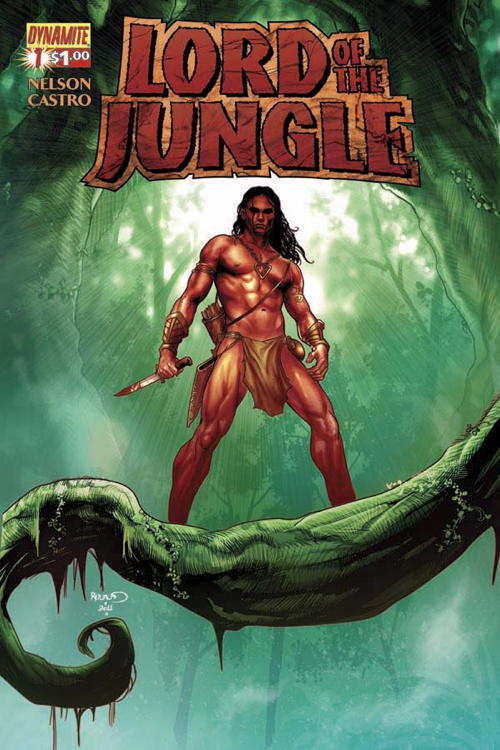
first issue has multiple variant covers, my copy is the Alex Ross
cover. It's a dynamic cover design with a crouching Tarzan decked
out in loin cloth, arm bands, wristbands, shoulder strap and wielding
a knife. Behind him are a bunch of gorillas. The colors are a bit
softer than I would expect, but it's still a nice cover. The “Lord
of the Jungle” masthead is a strong design that looks carved from
the wood of a tree.
 |
| Lucio Parillo cover |
I expected the comic to set out on its
own path with a quick origin recap, so I was surprised to find the
comic appears to be actually adapting the original TARZAN OF THE
APES novel by Edgar Rice Burroughs. And, in the pattern of modern
comic book storytelling, they are adapting it over the course of
several issues as this one comic barely gets through the first 3 or 4
chapters of the novel (and that's by ignoring the set-up with the
mutiny on the ship that leads to John and Alice Clayton being
abandoned to the coastline of the Belgian Congo).
As adaptations go, it is pretty
faithful to the book. The passage of time goes quickly as John
builds an elaborate tree house to keep his pregnant wife safe from
the dangers on the ground. The primary danger is shown to be a tribe
of aggressive and powerful apes. In the novels, they are called
Mangani and are described as a previously unknown species of great
apes that is somewhere in intelligence higher than gorillas (Bolgani)
but lesser than humans.
Most adaptations in film and TV have
just ignored this aspect and made the apes into gorillas for purposes
of telling the story. I'm not sure, yet, where writer Arvid Nelson
is going with his adaptation because the apes in this comic appear to
be gorillas and communicate with your basic “ooh ooh” ape-talk
rather than the Mangani language that Burroughs described. However,
there is an interlude with some Bantu tribesmen entering the jungle
who encounter a vicious tribe of man-eating ape-like creatures that
are identified with this exclamation: “What are these things?!
They're not apes, they're not men—what are they?!”
 |
| Ryan Sook cover |
They look very much like some of
Frazetta's ape-monsters. They look like apes but are taller and
leaner than the apes seen elsewhere in the comic and they wear loin
cloths, armbands, and use knives. So, I don't know exactly how the
whole Mangani versus Bolgani thing is going to eventually come down
in this title, but what I read is intriguing.
This issue covers the nearly 2 years in
which the Claytons arrive in the jungle, have the baby, and then
meet their end so that the baby, John, can be adopted by a female ape
who has just had her newborn brutally murdered by the bull ape who
leads their tribe. It's a familiar story and retold quite well
(although I'm sure Nelson had to find it funny to be writing things
like “Aah! Aah! Aah!”, “Rah! Rah!”, and “Ooh! Ooh!” into
a script).
The art is reminiscent of Neal Adams'
Tarzan covers and drawings without directly copying it. Clearly
Adams and Frazetta are an inspiration to artist Roberto Castro in his
approach to the this comic book. I am going to once again ring that
bell I ring everytime I review a Dynamite comic book though. It
would benefit from using an inker rather than coloring directly on
the pencils. There are moments where it works, but most of the time
the line work is lacking and the color is overcompensating. It's a
well-drawn comic. It would be stronger with a good inker and more
subdued coloring.
 |
| Paul Renaud cover |
POSTSCRIPT: Most people these days
seem a bit more knowledgeable about copyright issues than they were
just a mere 10 years ago, so it probably isn't news to anyone about
why Dynamite is publishing a “Tarzan” comic book without the name
“Tarzan” in the title anywhere. In the briefest way possible, it
boils down to fact that while the first few “Tarzan” novels have
slipped into the public domain, thus allowing Dynamite (or anyone) to
adapt and do derivative works based on those; the fact that these
stories are public domain has no bearing at all on the “Tarzan”
trademark still owned by the estate of Edgar Rice Burroughs. If
Dynamite wants to stick “Tarzan” in the title they would have to
get permission from, and pay a licensing fee to, the ERB estate. So,
they chose a descriptive title that evokes “Tarzan” without
violating the ERB trademark.
Being the nerd that I am, I made the
mistake of reading the indicia at the beginning of the comic just to
confirm for myself that there were no attributions to or permissions
from the ERB estate. But what I did find was that “Lord of the
Jungle” is listed not as a trademark of Dynamite Entertainment but
of “Savage Tales Entertainment, LLC.” So, I tried to do a little
research to find out just who “Savage Tales Entertainment, LLC”
happens to be and what I found was a bit confusing. I couldn't find
anyone publicly associated with “Savage Tales,” yet they appear
to be out there just basically squatting on any unused publishing
trademarks they can find. For example, I found “Savage Tales”
claiming trademark ownership of Pete Morisi's “Peter Cannon,
Thunderbolt”...since 1966? “Savage Tales” claims they own the
trademark to “Charlton Comics”, “The Human Fly”, and other
obscure marks like that. I don't know exactly what's happening, but
it appears they are doing like web domain squatters but with
trademarks. I sent a message last week to the attorney listed on the recent legal ruling In Re Savage Tales Entertainment, LLC just
to ask for clarification. He was under no obligation to reply
back...and he didn't. So, the best I can do is speculate. My best
guess is that based on Dynamite's pattern of digging out old public
domain characters and grabbing trademarks on new versions of them,
that “Savage Tales” is a subsidiary of some sort (or a partner)
with Dynamite and they function as the licensing subsidiary of
Dynamite. That would offer some legal protection to Dynamite they
might not otherwise have. Setting up “Savage Tales” as an LLC
gives an even greater degree of personal legal protection.
That's my best guess. I would love to
know for sure but information is hard to dig up online and the couple
of people I contacted to ask about it either had no information or
were unwilling to share. So, there you go. The comic's pretty good,
but I have no clue what's going on with the whole “Lord of the
Jungle” trademark thing.

Sunday, June 12, 2011
Quite Possibly My Favorite Movie Poster EVER!!!!
When Captain America throws his mighty shield,
All those who chose to oppose his shield must yield.
If he’s led to a fight and a duel is due,
Then the red and white and the blue’ll come through
When Captain America throws his mighty shield!
All those who chose to oppose his shield must yield.
If he’s led to a fight and a duel is due,
Then the red and white and the blue’ll come through
When Captain America throws his mighty shield!

Wednesday, October 27, 2010
It's Haalllllloweeeen
Halloween themed reviews for AICN. Both very different but very good. THE GREEN WOMAN is for adults only and gruesome. SCARY GODMOTHER is for all ages, especially kids, and beautiful. :)
 THE GREEN WOMAN HC OGN
Writers: Peter Straub & Michael Easton
“You could call this the last act. Hell, you could call it the encore, it's pretty much the same to me.”
-- Fielding “Fee” Bandolier
Vertigo has released THE GREEN WOMAN just in time for Halloween and it's a treat for fans of mature horror stories. Full of graphic gore and violence throughout, this book is not for the faint of heart. This is a serial killer story, so any reader needs to know that up front. For whatever reason, we seem as a culture to be fascinated by the insidiously macabre nature of the serial killer. Neil Gaiman made use of it in SANDMAN, Hannibal Lector has practically become the adult "boogey man" go to for evil, and DEXTER thrives as the ultimate anti-hero juggling life as a father and also as a man who fetishistically needs to kill people. So, yes, we are fascinated by serial killers. In THE GREEN WOMAN, Straub and Easton resurrect a serial-killer character Straub created in his "Blue Rose" trilogy of books (KOKO, MYSTERY, and THE THROAT). Fielding "Fee" Bandolier was believed dead at the end of THE THROAT, but as THE GREEN WOMAN makes explicitly clear a number of times...writers are never to be trusted with telling the truth. And in Straub's case, the implication is that the apparent death of Fee was just that -- apparent.
Anyone who wants to read of the final fate of Fee needs to read THE GREEN WOMAN. Which begs the immediate question for fans of graphic novels: do you need to read the "Blue Rose" trilogy first to enjoy THE GREEN WOMAN? The answer is a resounding "No." In fact, prior to reading THE GREEN WOMAN, I had only read Straub's GHOST STORY and his 2 collaborations with Stephen King. But I have now picked up the "Blue Rose" books to read as a result of THE GREEN WOMAN. Similar to Easton's manner of storytelling that I recognize from his SOUL STEALER graphic novel, THE GREEN WOMAN is non-linear storytelling. So, the reader needs to commit to the book as Straub and Easton let all the puzzle pieces that are shuffled around come together by the end to finish with a complete picture of each character's place and purpose in the universe.
At a glance, the plot is your standard hackneyed plot of the tortured cop on the trail of a serial killer who then gets drawn into the twisted mind of the killer. There's so much more, however, to this book than mere plot. In fact, most plots, when culled to their base concept, are rarely original. What matters in fiction is how that plot unfolds. Bob Steele is the cop. Fee Bandolier is the killer. The "Green Woman" is a pub that provides the location that bookends this story. "She" is also personalized by the image of the "Green Woman" carved into the wall and her stunning beauty and dark eyes pierce the soul (if he has one) of Fee. Her image haunts him as much as his lost love. But the "Green Woman" does more than just haunt...she tempts...she entices...she embodies the perfect representation of the darkest thoughts of man. By jumping back and forth through Fee's life, we gain insight into his repulsive, yet charismatically appealing nature. There was a time when he basically experienced joy in his "calling," but now he's getting old, he's getting tired, and like a once great hunter wolf....he is lashing out and he's losing satisfaction in his actions because within him he feels the pull to accept that his time is nearly at an end.
There is a malevolent force at work here that transcends just a mere "man's inhumanity to man" type of story. Fee survives because evil thrives within him. Steele is pushed into a heroic role he does not desire nor is he capable of fulfilling. Both are pulled down into the depths of hell within themselves and they leave a trail of horror behind them always trekking toward...the "Green Woman." In the end, both Steele and Fee confront whatever "reward" their lives have earned them. And the "Green Woman"? I swear there is just a hint of self-satisfied smile as Fee's story comes to an end...but the spirit that drove him has taken root once again.
Gruesomely beautiful art by John Bolton tells the story visually with his unmatched ability to deliver images that are hauntingly sensual and brutally horrific without any sense of choppiness to the storytelling. Bolton's panels are at times starkly sexual and other times darkly introverted and emotional. I am sure this story could be told as prose, but for me the visuals accompanying this story allow it to unfold emotionally rather than intellectually. It is one of the benefits of graphic novels by their very nature. Reading prose requires an intellectual process first before it can connect with the heart. Art, however, evokes a visceral reaction first and then the intellectualizing can begin. In a book like THE GREEN WOMAN, the art is what hits first, therefore the first reaction is emotional and the text is taken in after that. Bolton, like all great painter-storytellers, understands this need to draw in the reader/viewer emotionally. There is a lot of blood and gruesome imagery, but it all serves the feeling of the moment and the story overall. Bolton's all-important choice of the face of the "Green Woman" is a beauty with a timeless sense of perfection but a burning wickedness behind her eyes. Bolton's art here is a masterpiece and along with the writing, THE GREEN WOMAN should satisfy any fan of intelligent and grisly psychological horror.
--------------------------------------------
 SCARY GODMOTHER HC OGN
Writer/Artist: Jill Thompson
“Anybody who's all about monsters an' spiders an' candy is the perfect girl for me. Besides...you're never too old to be a new friend.”
– Jimmy
For ghouls and goblins of all ages, Jill Thompson's gorgeous new SCARY GODMOTHER book collection has hit the stands to usher in the Halloween season. Dark Horse has beautifully packaged Thompson's first four SCARY GODMOTHER children's books into a large hardback evocative of the classic MOTHER GOOSE book...complete with a “This Book Belongs to ____” plate on the checkerboard endpapers. SCARY GODMOTHER collects in one volume: “Scary Godmother”, “The Revenge of Jimmy”, “Mystery Date”, “The Boo Flu”, and adds in the short story “Tea for Orson.” Also included in this package are lots of treats including Thompson's initial sketch work for the characters, some of the original covers, and her character expression sheets for the animated specials developed for Cartoon Network based on her first two SCARY GODMOTHER books.
Fans of Thompson's comic book work may only be familiar with her Scary Godmother character through the series of comic books with the character. So, this book is an opportunity to encounter her in a different type of format that really gives Thompson's lush watercolor art the focus. And each story is a joy to read. Thompson really understands how to tap into that wonderfully open spirit of childhood and craft stories that will connect with anyone. The bottom line as to why I recommend this book so much is simply how much FUN they are. They bring a smile to your face and a chuckle to your throat as you read it. You can't help it. My own daughter is 13 years old and was instantly drawn to the cover when she got in the car after her gymnastics class. “What's that?” she asked with a crinkle of her nose. I replied “Check it out. I bet you will love it.” And needless to say, she didn't put it down until she had read the entire book and declared she “loooooooovvvvvvves SCARY GODMOTHER....especially Bug-A-Boo!” She just about jumped out of her skin with excitement when we came across a DVD copy of the “Scary Godmother: Jimmy's Revenge” animated special. Guess what daddy bought and we are waiting to watch together on Halloween night?
Scary Godmother is basically the patron saint of Halloween. She is the guardian of the spirit of Halloween and she comes onto the scene in these books to protect sweet innocent little Hannah Marie from the “monsters.” As each story progresses, Hannah Marie, her cousin Jimmy, and her friends become increasingly more familiar with Scary Godmother and all her friends who live with her on the “Fright Side”. The sweet-natured characters that populate the “Fright Side” include the closet skeleton, Mr. Pettibone, the ghostly cat Boozle, and the monster under your bed, Bug-A-Boo. Harry is a scene-stealing werewolf and Hannah Marie quickly becomes best friends with Orson, the bespectacled boy vampire.
Thompson's character designs are appealing with that slight creep factor that makes them all feel right for Halloween. I love the consistency in design elements that run through all her illustrations...including the cute curly-cue element that shows up everywhere including the logo design. In the age of digital art, I am particularly drawn to Thompson's colorful washes and brushed textures in the color work. I especially enjoy how she is willing to let the watercolors flow and absorb into the paper softening and stylizing many elements such as the moon in the night sky. Never a perfect circle, she lays down the deep purples and blues of the night sky around the moon but never makes the effort to tighten it up. I love that choice and she makes many confident artistic choices like that in her storytelling. She has the experience and the eye to always know the most effective (whether dramatic or comedic) way to communicate the scene to the reader.
Even though these stories were designed for book form rather than comic form, she is essentially working with a large-form panel design. So, the fan of comics and graphic novels should have no problem with her approach here. In fact, they may see this as a chance to expand their thinking as to what can be accomplished within the panel-to-panel style of story.
Halloween is the time for tricks and treats, and Jill Thompson's SCARY GODMOTHER is a treat that even beats finding a full-sized Snickers in your trick-or-treat bag.
 THE GREEN WOMAN HC OGN
Writers: Peter Straub & Michael Easton
Artist: John Bolton
Publisher: Vertigo/DC Comics
“You could call this the last act. Hell, you could call it the encore, it's pretty much the same to me.”-- Fielding “Fee” Bandolier
Vertigo has released THE GREEN WOMAN just in time for Halloween and it's a treat for fans of mature horror stories. Full of graphic gore and violence throughout, this book is not for the faint of heart. This is a serial killer story, so any reader needs to know that up front. For whatever reason, we seem as a culture to be fascinated by the insidiously macabre nature of the serial killer. Neil Gaiman made use of it in SANDMAN, Hannibal Lector has practically become the adult "boogey man" go to for evil, and DEXTER thrives as the ultimate anti-hero juggling life as a father and also as a man who fetishistically needs to kill people. So, yes, we are fascinated by serial killers. In THE GREEN WOMAN, Straub and Easton resurrect a serial-killer character Straub created in his "Blue Rose" trilogy of books (KOKO, MYSTERY, and THE THROAT). Fielding "Fee" Bandolier was believed dead at the end of THE THROAT, but as THE GREEN WOMAN makes explicitly clear a number of times...writers are never to be trusted with telling the truth. And in Straub's case, the implication is that the apparent death of Fee was just that -- apparent.
Anyone who wants to read of the final fate of Fee needs to read THE GREEN WOMAN. Which begs the immediate question for fans of graphic novels: do you need to read the "Blue Rose" trilogy first to enjoy THE GREEN WOMAN? The answer is a resounding "No." In fact, prior to reading THE GREEN WOMAN, I had only read Straub's GHOST STORY and his 2 collaborations with Stephen King. But I have now picked up the "Blue Rose" books to read as a result of THE GREEN WOMAN. Similar to Easton's manner of storytelling that I recognize from his SOUL STEALER graphic novel, THE GREEN WOMAN is non-linear storytelling. So, the reader needs to commit to the book as Straub and Easton let all the puzzle pieces that are shuffled around come together by the end to finish with a complete picture of each character's place and purpose in the universe.
At a glance, the plot is your standard hackneyed plot of the tortured cop on the trail of a serial killer who then gets drawn into the twisted mind of the killer. There's so much more, however, to this book than mere plot. In fact, most plots, when culled to their base concept, are rarely original. What matters in fiction is how that plot unfolds. Bob Steele is the cop. Fee Bandolier is the killer. The "Green Woman" is a pub that provides the location that bookends this story. "She" is also personalized by the image of the "Green Woman" carved into the wall and her stunning beauty and dark eyes pierce the soul (if he has one) of Fee. Her image haunts him as much as his lost love. But the "Green Woman" does more than just haunt...she tempts...she entices...she embodies the perfect representation of the darkest thoughts of man. By jumping back and forth through Fee's life, we gain insight into his repulsive, yet charismatically appealing nature. There was a time when he basically experienced joy in his "calling," but now he's getting old, he's getting tired, and like a once great hunter wolf....he is lashing out and he's losing satisfaction in his actions because within him he feels the pull to accept that his time is nearly at an end.
There is a malevolent force at work here that transcends just a mere "man's inhumanity to man" type of story. Fee survives because evil thrives within him. Steele is pushed into a heroic role he does not desire nor is he capable of fulfilling. Both are pulled down into the depths of hell within themselves and they leave a trail of horror behind them always trekking toward...the "Green Woman." In the end, both Steele and Fee confront whatever "reward" their lives have earned them. And the "Green Woman"? I swear there is just a hint of self-satisfied smile as Fee's story comes to an end...but the spirit that drove him has taken root once again.
Gruesomely beautiful art by John Bolton tells the story visually with his unmatched ability to deliver images that are hauntingly sensual and brutally horrific without any sense of choppiness to the storytelling. Bolton's panels are at times starkly sexual and other times darkly introverted and emotional. I am sure this story could be told as prose, but for me the visuals accompanying this story allow it to unfold emotionally rather than intellectually. It is one of the benefits of graphic novels by their very nature. Reading prose requires an intellectual process first before it can connect with the heart. Art, however, evokes a visceral reaction first and then the intellectualizing can begin. In a book like THE GREEN WOMAN, the art is what hits first, therefore the first reaction is emotional and the text is taken in after that. Bolton, like all great painter-storytellers, understands this need to draw in the reader/viewer emotionally. There is a lot of blood and gruesome imagery, but it all serves the feeling of the moment and the story overall. Bolton's all-important choice of the face of the "Green Woman" is a beauty with a timeless sense of perfection but a burning wickedness behind her eyes. Bolton's art here is a masterpiece and along with the writing, THE GREEN WOMAN should satisfy any fan of intelligent and grisly psychological horror.
--------------------------------------------
 SCARY GODMOTHER HC OGN
Writer/Artist: Jill Thompson
Publisher: Dark Horse Books
“Anybody who's all about monsters an' spiders an' candy is the perfect girl for me. Besides...you're never too old to be a new friend.” – Jimmy
For ghouls and goblins of all ages, Jill Thompson's gorgeous new SCARY GODMOTHER book collection has hit the stands to usher in the Halloween season. Dark Horse has beautifully packaged Thompson's first four SCARY GODMOTHER children's books into a large hardback evocative of the classic MOTHER GOOSE book...complete with a “This Book Belongs to ____” plate on the checkerboard endpapers. SCARY GODMOTHER collects in one volume: “Scary Godmother”, “The Revenge of Jimmy”, “Mystery Date”, “The Boo Flu”, and adds in the short story “Tea for Orson.” Also included in this package are lots of treats including Thompson's initial sketch work for the characters, some of the original covers, and her character expression sheets for the animated specials developed for Cartoon Network based on her first two SCARY GODMOTHER books.
Fans of Thompson's comic book work may only be familiar with her Scary Godmother character through the series of comic books with the character. So, this book is an opportunity to encounter her in a different type of format that really gives Thompson's lush watercolor art the focus. And each story is a joy to read. Thompson really understands how to tap into that wonderfully open spirit of childhood and craft stories that will connect with anyone. The bottom line as to why I recommend this book so much is simply how much FUN they are. They bring a smile to your face and a chuckle to your throat as you read it. You can't help it. My own daughter is 13 years old and was instantly drawn to the cover when she got in the car after her gymnastics class. “What's that?” she asked with a crinkle of her nose. I replied “Check it out. I bet you will love it.” And needless to say, she didn't put it down until she had read the entire book and declared she “loooooooovvvvvvves SCARY GODMOTHER....especially Bug-A-Boo!” She just about jumped out of her skin with excitement when we came across a DVD copy of the “Scary Godmother: Jimmy's Revenge” animated special. Guess what daddy bought and we are waiting to watch together on Halloween night?
Scary Godmother is basically the patron saint of Halloween. She is the guardian of the spirit of Halloween and she comes onto the scene in these books to protect sweet innocent little Hannah Marie from the “monsters.” As each story progresses, Hannah Marie, her cousin Jimmy, and her friends become increasingly more familiar with Scary Godmother and all her friends who live with her on the “Fright Side”. The sweet-natured characters that populate the “Fright Side” include the closet skeleton, Mr. Pettibone, the ghostly cat Boozle, and the monster under your bed, Bug-A-Boo. Harry is a scene-stealing werewolf and Hannah Marie quickly becomes best friends with Orson, the bespectacled boy vampire.
Thompson's character designs are appealing with that slight creep factor that makes them all feel right for Halloween. I love the consistency in design elements that run through all her illustrations...including the cute curly-cue element that shows up everywhere including the logo design. In the age of digital art, I am particularly drawn to Thompson's colorful washes and brushed textures in the color work. I especially enjoy how she is willing to let the watercolors flow and absorb into the paper softening and stylizing many elements such as the moon in the night sky. Never a perfect circle, she lays down the deep purples and blues of the night sky around the moon but never makes the effort to tighten it up. I love that choice and she makes many confident artistic choices like that in her storytelling. She has the experience and the eye to always know the most effective (whether dramatic or comedic) way to communicate the scene to the reader.
Even though these stories were designed for book form rather than comic form, she is essentially working with a large-form panel design. So, the fan of comics and graphic novels should have no problem with her approach here. In fact, they may see this as a chance to expand their thinking as to what can be accomplished within the panel-to-panel style of story.
Halloween is the time for tricks and treats, and Jill Thompson's SCARY GODMOTHER is a treat that even beats finding a full-sized Snickers in your trick-or-treat bag.
Thursday, September 23, 2010
ATLAS COMICS...UNBOUND!
 An AICN chat with Atlas Comics' Jason Goodman and Brendan Deneen
In 1974, Marvel and DC found themselves challenged directly in the newsstand market by upstart Atlas Comics founded by Martin Goodman (founder of Marvel Comics). Atlas Comics were marked by a trade-dress and style that was intentionally similar to the Marvel Comics of the time – a bold and direct assault on the House of Ideas.
The success of Atlas Comics was short-lived, less than 2 years, but during that brief period of time they churned out some surprisingly strong comics written and drawn by some of the best in the business (Archie Goodwin, Michael Fleischer, Larry Hama, Howard Chaykin, Neal Adams, Mike Sekowsky, Steve Ditko, and more). However, when Atlas ceased publication, their rather large stable of characters disappeared...seemingly forever.
To most comic fans, Atlas has survived in memory as little more than an interesting footnote lost to history. For the industry though, Atlas was a pioneer as the first comics publisher to increase pay rates and provide co-ownership/profit-sharing opportunities for their creative artists. And most historically, Atlas was the first to return all artwork to the artists who produced the works. And that's where Atlas began and ended in comics history over three decades ago.
Last week, the comics industry was uniformly surprised to see an announcement that, in partnership with Ardden Entertainment, Jason Goodman (grandson of Martin Goodman) is planning to re-launch Atlas Comics at the New York Comic-Con on October 8, 2010. Ardden’s Editor-in-Chief and legendary comic writer, J.M. DeMatteis, was quoted in the announcement on Ardden's website saying “"The Atlas universe is filled with characters of tremendous potential. I look forward to being a part of this re-launch as we re-imagine these wonderful characters and send them off on new adventures for the first time in thirty-five years."
I immediately contacted Brendan Deneen, Co-President of Ardden Entertainment to talk about this new project. The following column is the result of a virtual chat between Deneen, Goodman, and myself conducted over the course of about 4 or 5 days.
ME: I would like to begin this conversation with Brendan Deneen. Tell me a little about how you got from the position of Production Executive at Dimension/Miramax Films to Co-President of Ardden Entertainment?
BRENDAN DENEEN (BD): Okay. I befriended Rich Emms when I was working as a book- and comic-to-film scout for Dimension/Miramax Films. In that role, I had come across a series called DARKHAM VALE that Rich was publishing through his small UK company, AP Comics. He would later go on to become Editor-in-Chief of Markosia.
 During a visit to the States, he invited me to join him on a trip to the Wizard Magazine offices in Congers New York. We had a really good time during the bus ride, bonding over comics we loved, such as the Byrne/Claremont run on X-MEN. At one point, I pitched him a comic idea I created when I was 19 years old (in 1991!) called SCATTERBRAIN.
He seemed interested but I thought he was just being polite.
 During a visit to the States, he invited me to join him on a trip to the Wizard Magazine offices in Congers New York. We had a really good time during the bus ride, bonding over comics we loved, such as the Byrne/Claremont run on X-MEN. At one point, I pitched him a comic idea I created when I was 19 years old (in 1991!) called SCATTERBRAIN.
He seemed interested but I thought he was just being polite.
ME: Ha!
BD: About a month later, he brought it up and said he wanted to publish it. During that time, I believe, is when he was hired by Markosia as their EiC, and he brought SCATTERBRAIN with him and published it in 2006. We got great quotes from Michael Avon Oeming, Brian K. Vaughan, Geoff Johns, Jim Krueger, and Robert Kirkman; and some great reviews, including you guys, who called it one of the best indie books of the year.
I had been trying for years before that to get noticed by Marvel or DC but no luck, despite knowing editors at both companies. I figured SCATTERBRAIN would be the beginning and end of my comic writing career.

I had been trying for years before that to get noticed by Marvel or DC but no luck, despite knowing editors at both companies. I figured SCATTERBRAIN would be the beginning and end of my comic writing career.

ME: It’s not an easy business to break into professionally these days outside of self-publishing. There was a time when even a person with marginal talent could find himself writing or drawing comics simply because he just happened to be around at the moment that an editor needed to fill a slot.
BD: Totally true! Anyway...one day, out of the blue, Rich emailed me and said "Hey, do you want to put together a Flash Gordon pitch?"
And I was like.... "Uh... HELLS YES!"
So, I put together a 4 or 5 page pitch, which would eventually become THE MERCY WARS arc. I also had the bare bones for the second and third arcs at that point as well. After they had read my treatment (and liked it), they then said, "Actually, there's this new Flash Gordon show coming up, would you be willing to do a new treatment set in the world of the show?"
And I was like.... "Uh... HELLS YES!"
So, I put together a 4 or 5 page pitch, which would eventually become THE MERCY WARS arc. I also had the bare bones for the second and third arcs at that point as well. After they had read my treatment (and liked it), they then said, "Actually, there's this new Flash Gordon show coming up, would you be willing to do a new treatment set in the world of the show?"
ME: Ugh.
BD: I read a few of the episode scripts and came up with what I thought was a really bad ass WRATH OF KHAN-esque arc that took place between, I think, episodes 2 and 3.


ME: What did they think of it?
BD: They loved it...but then the show came out and...well, everyone knows that happened there.
So, I re-approached them with my original concept and they approved it. However, when I shopped the project around to a number of big publishers...NO ONE WAS INTERESTED! Image wouldn't even return my emails. It was almost laughable.
So, I re-approached them with my original concept and they approved it. However, when I shopped the project around to a number of big publishers...NO ONE WAS INTERESTED! Image wouldn't even return my emails. It was almost laughable.
ME: That seems odd for a property as much a part of the popular lexicon as FLASH GORDON. I mean...it's friggin' FLASH GORDON!
BD: Exactly. So, Rich said we should start our own company...and that's just what we did!


ME: So, you and Rich went into business initially to publish the FLASH GORDON comic. How did J.M. DeMatteis come into it?
BD: Well, by that point, I was a literary and film agent and I had just started representing him. He said, "Hey, if you ever want something more than a writer, let me know." And I said something like "How about Editor-in-Chief?" and he said, "Sure."
That's a bit truncated...but not much!
That's a bit truncated...but not much!
ME: You make it sound so simple...
BD: It was very smooth. He and I already had a great working relationship and I knew him from my time at Dimension/Miramax.
ME: And the comic was well-received?
 BD: We released FLASH GORDON #0 at the 2008 NY Comic-Con and sold out of a couple thousand issues over the weekend. We were blown away by the reception.
The first six issues sold very well and the critical response was, I'd say, 75/25 positive. Some people had problems with my writing or Paul's art, but most people loved the fact that I hewed so closely to Alex Raymond's concepts and that I was having FUN with it!!
And JM's notes were HUGELY helpful.
ME: So, this is about 2 years ago. In those 2 years, you've published FLASH GORDON successfully and grabbed a license from Harvey Comics to modernize Casper, Wendy, and Hot Stuff. But now...you're relaunching an entire line of comics that are mostly known as a historic footnote from the mid-70s. How does this happen?
BD: For CASPER, J.M. and I just put together a KILLER concept, and I think Classic Media recognized that immediately. The book was (obviously) plagued with delays but we're VERY proud of it.
 We're in talks right now with Classic to do a sequel.
 We're in talks right now with Classic to do a sequel.
ME: Seriously, one of my favorite comics of the last year. There's actually a very solid bunch of comics being published right now for the younger market that are very good for all ages and CASPER & THE SPECTRALS is one of them.
BD: Thank you! We appreciate it so much. Anyway, my mind started thinking about other licenses to pursue and for some reason, i thought of Atlas.
I had bought all those comics from the back issue bin when i was younger.
I had bought all those comics from the back issue bin when i was younger.
ME: A perfect transition point to bring Jason Goodman into this conversation. Jason, I'm curious about you and the process that got you to this point where you are about to perform the rather daunting task of relaunching your grandfather's line of comics.
 JASON GOODMAN (JG): For me, fortunately, this journey began at birth. The bounty of comics that arrived daily at home was more than any kid could ask for - Marvel & Atlas - all hot off the presses! In what could most generously be described as the folly of youth (and most harshly as an act of pure idiocy/lunacy, albeit by a 10 year old), I sold my childhood comic collection in the late 70’s at my lemonade stand on the corner 90th St. and West End Ave. (pre-Antiques Roadshow). Fast forward through college and a Wall Street career to the mid-90’s when I finally went into the family business after my dad (Chip Goodman) passed. For 15 years now, I have published consumer magazines in every field from Log Homes to Pilates. However, I have always treasured the Atlas titles and characters and was waiting for the right moment to re-introduce them to the world – a moment when I had enough time to seriously devote to the project, and the right people to work with.
BD: I reached out to Jason and it turned out he was talking to a number of places already. We started meeting in New York City and just really hit it off. He had a cool vision for what he wanted the books to be, and had this great core of advisors and the four us just started brainstorming ways to bring the brand back.
 It took awhile, because there were a lot of pieces to put together, but apparently it was worth it!!
JG: Brendan and the Ardden Entertainment gang, and my own creative team – they all have great passion, talent and intensity – I’m having a blast!
ME: Can you share a little of the vision? I ask because you're talking about reintroducing these characters into a market that feels almost overrun by super-heroes. How do you take these characters, clearly modeled on the late silver age Marvel style, and make them relevant and stand out from the crowd? I carry deeply-rooted nostalgia for many of the characters, but we have 2 or 3 generations of readers with no foreknowledge of Atlas at all. What's the pitch?
JG: The goal, put most simply, is to tell great stories! In that regard, we have a world-class creative legacy to build on. I won’t presume to bore you with the multimedia, cross-platform, multi-channel licensing, etc...suffice it to say, it’s all true and this is a money-making (should I say "profit seeking"?) enterprise - just a ridiculously fun and cool one.
 BD: The key is that these are MORE than just superheroes. We're going to approach each title with that attitude....a great story first and more than just a couple of guys in spandex beating the crap out of each other. PHOENIX is a science fiction story more than it is a superhero story. It's about a dude who is abducted by aliens, imbued with crazy powers, and then escapes!! And THE GRIM GHOST is this horror/thriller about a man trapped between life and death.
 BD: The key is that these are MORE than just superheroes. We're going to approach each title with that attitude....a great story first and more than just a couple of guys in spandex beating the crap out of each other. PHOENIX is a science fiction story more than it is a superhero story. It's about a dude who is abducted by aliens, imbued with crazy powers, and then escapes!! And THE GRIM GHOST is this horror/thriller about a man trapped between life and death.
ME: I bought the original PHOENIX #1 in Puerto Rico....I guess I was 3rd or 4th grade!
BD: Nice!!!
ME: In fact, I bought a number of Atlas comics when they were first published -- PHOENIX, GRIM GHOST, SCORPION, LOMAX, PLANET OF THE VAMPIRES...
BD: Over the last week or so, I've been blown away by how many people have fond memories of them...including me!
ME: One of my personal favorites was FRIGHT starring THE SON OF DRACULA by Gary Friedrich & Frank Thorne. I kept looking and looking for that second issue....that never arrived! Any chance of reprint collections?
BD: We're talking about reprints! But that's another story.


ME: Of the concepts you are working on right now, do you expect to pick up any of the series from the point where they originally stopped or reimagine each one for the modern audience?
JG: Modernization is a natural – comics have always changed with the times. But you’re correct, the opportunity exists for us to take some truly nascent original Atlas story lines and start straight from there. Stay tuned.
ME: Okay. The characters are more than just super-heroes. That jumps the hurdle of Dynamite's PROJECT SUPERPOWERS. Are you looking at creating a whole "shared universe" concept or are you dealing with them as stand-alone concepts or some sort of combination?
BD: Stand-alone concepts for now. I love shared universes but I think that can become very dense, very quickly. I would love to do a big shared universe some day but i don't think it makes sense for Atlas.
ME: Are you planning ongoing series or...rather...a series of mini-series for the different concepts. Similar to your successful approach to FLASH GORDON?
BD: Yes, exactly. The first arc of each will be the origin story.


ME: You realize, of course, that PLANET OF VAMPIRES needs to seriously be front-loaded.
BD: Ha, yes.
ME: Seriously. Before the big vampire glut implodes.
JG: I stand proudly on my sunlit altar, wreathed in garlic, and say, “I fear no glut.” Seriously, though, we are going to roll these books out slowly, taking our time to pick the perfect creative teams and modern storylines for each one. We have no plans to dump a bunch of mediocre titles into the marketplace and hope for the best. We're here for the long term and we want each book to be as good as it possibly can. We think people are going to love what we have up our collective sleeves!
BD: It's funny because everyone has their favorite! We have an AWESOME concept for WULF, a very cool BRUTE idea that moves him totally away from "Hulk" and a great way to do IRON JAW. I'm not sure which titles will be next but we are talking about ALL of them. We're very, very excited.

BD: It's funny because everyone has their favorite! We have an AWESOME concept for WULF, a very cool BRUTE idea that moves him totally away from "Hulk" and a great way to do IRON JAW. I'm not sure which titles will be next but we are talking about ALL of them. We're very, very excited.

ME: Any chance you're talking to some of the original writers and artists about contributing to the new line? In particular, I will sleep much better after this interview if I know you have at least APPROACHED Howard Chaykin about creating new stories for THE SCORPION.
BD: We're already talking to some A-list writers about a number of the titles.
ME: That's not a "no".
JG: I wouldn’t want to diminish your journalistic vigilance by giving you answers that would help you sleep at night.
ME: *sigh* I got to talking last week with a grumpy old fan and he expressed a cynical reaction to your announcement because he said Atlas was just an old Marvel rip-off. That type is going to be your toughest sell I think. So, from a marketing standpoint give me your approach to drawing in the jaded fan who might love the new Atlas if he would just give it a chance.
 BD: I don't necessarily agree with that assessment of those original titles. But even if I did, we're approaching these with a 21st century mentality. And honestly, I've been developing intellectual property professionally for over a decade. I know comic books, novels and movies inside and out. I'm an editor at a major publishing company. I know good stories and how to develop them. And Jason has a great perspective on these things, too, and has this amazing Goodman legacy. We are updating the original stories while staying true to the core concepts of what made them so cool in the first place.
ME: Hell...all characters are derivative of some other character in some way. Even Superman was derivative of Doc Savage who was derivative of Gladiator who was derivative of Hercules...
BD: ...and Flash Gordon was King Features' answer to Buck Rogers.
ME: It is what you do with the character and the concept that makes it or breaks it.
In recent years, Marvel/Disney bought out Malibu and CrossGen and is in the process of relaunching some CrossGen titles. DC has licensed the Red Circle characters and the THUNDER Agents, plus bought the Milestone line and appears to be rolling the WildStorm characters into the DC Universe. Dynamite and ABC both brought back a number of public domain characters. With such a crowded market, how does Atlas make themselves relevant to the market and translate that into sales?
JG: In today’s business world, it is very difficult to find a market that isn’t extremely competitive – sometimes you just need a reason, the right reason. In my case, a great family history; a solid foundation of titles; a loyal, pre-existing fan base; and some great people to work with. One of the many great blessings of Atlas is that we have a deep bench of titles and characters to draw from. The nature of each story we tell will influence frequency and format....
ME: Do you see yourself making inroads with Atlas Comics in other retail venues than just local comic book stores? If so, what type of approach?
JG: Local comic book stores are the industry’s life blood and will continue to be the centerpiece of our retail distribution strategy. We certainly hope to supplement that with expansion into other classes of trade, and my consumer magazine experience (tens of millions of copies sold) should help that effort.
ME: Any insight into what's officially on the schedule (and when) and what is planned in the long term including writers and artists lined up?
BD: We'll be releasing the #0's for PHOENIX and GRIM GHOST via Diamond in the coming months, and then the monthly issues will start early 2011. Oh, the #0's will first be available at New York Comic-Con, then via Diamond/comic stores.
ME: I'm digging that GRIM GHOST cover. Who's the cover artist?
BD: Qing Ping Mui.
ME: Gesundheit!
BD: Ha! Someone on our team found him. The art on PHOENIX is by Ian and Guy Dorian. That's really all I can reveal right now.
JG: Forgive us if we keep some secrets...for just a while longer.
JG: Forgive us if we keep some secrets...for just a while longer.
ME: Who gets the credit for the fantastic design work on the logos, masthead and covers?
BD: Rich Emms has done all the design work, and he's incredible at it.
ME: Final question goes to Jason and refers to the Atlas "brand". When someone says "Atlas", what do you want them to think?
JG: What’s a nice boy like you doing in a business like this? or preferably AWESOME! Seriously though, I would like Atlas to stand for great stories that have been told and great stories still to come.ME: Thank you, both of you, Brendan and Jason, for your time and cooperation. I hope your efforts are rewarded and that you'll keep AICN and our readers in the loop on future Atlas and Ardden projects. Check out Ardden’s website and the Atlas Archives for more info!
Tuesday, September 21, 2010
DC Comics Bi-Coastal Press Release Interpreted

 -----------------------------------------------
Today at The Source, a press release announced that DC Entertainment/Comics was becoming bi-coastal. Here is the announcement (in yellow) along with my no-b.s. interpretation (in red).
DC Entertainment's ongoing strategy to diminish the importance of the publishing arm.
(September 21, 2010 – New York) DC Entertainment, as part of its ongoing strategy to integrate the DC Comics business, brand and characters into Warner Bros.
Entertainment’s content and distribution operations, will relocate its business functions related to and supporting multi-media and digital content production to Burbank, California. DCE’s publishing operations will remain in New York, continuing DC Comics’ 75-plus year legacy of leadership in the comic book arena. These announcements were made today by Diane Nelson, President, DC Entertainment.
We are moving everything and everyone of real importance to Hollywood. But we will continue to let the publishing arm plug along as a cheap feeder league for our Hollywood offices. At least for awhile.
“These organizational changes reinforce the strengths of DC’s greatest legacies – most importantly its people and its creative talent – and offer greater opportunity for maximum growth, success and efficiency in the future,” said Nelson.We're gonna be firing a lot of people.
“Our two offices will stretch and build their respective areas of focus, while prioritizing and aggressively striving to connect and cooperate more strongly than ever before between them and with their colleagues at Warner Bros.”
DC Entertainment's Hollywood offices will be dictating what DC Comics can and cannot do in New York.
“This strategic business realignment allows us to fully integrate and expand the DC brand in feature films as well as across multiple distribution platforms of Warner Bros. and Time Warner,” said Jeff Robinov, President, Warner Bros. Pictures Group, to whom Nelson reports. “We are creating a seamless, cohesive unit that will bring even more great characters and content to consumers everywhere.”
We can make such an enormous buttload of money off our licensing, web, film, and television we plan to focus primarily on these areas rather than the comics.
The relocation process is scheduled to be completed by the end of 2011, with DCE’s businesses related to the development and production of feature films, television, digital media, video games and consumer products as well as the company’s administrative functions relocating to a Warner Bros.-managed property in Burbank, CA. DC Comics’ publishing operations, which have been the bedrock since the company’s inception with an annual output of over 1,100 comic books, 300 graphic novels and MAD magazine, will remain in New York. The bi-coastal business units will work more closely together to continue elevating the powerful DCE brand.Once we get everyone settled comfortably in Hollywood, we will reevaluate whether the New York offices are even necessary anymore. This should happen sometime early in 2012.
DC Entertainment was founded in September 2009 to fully realize the power and value of the DC Comics brand and characters across all media and platforms. The senior management team responsible for shepherding DCE through this reorganization is comprised of Nelson, Geoff Johns, Chief Creative Officer; John Rood, Executive Vice President, Sales, Marketing and Business Development; and Jim Lee and Dan DiDio, Co-Publishers of DC Comics.The DC Entertainment reorganization team are of prime importance to the brand except for one of the last two on the list who may want to be sure his resume is up to date.
=======================================
A little bit later in the day, a second press release came out that was ostensibly a "letter" from Dan Didio and Jim Lee as co-publishers of DC Comics to clear up the earlier announcement. The "co-publishers" designation makes me think about Michael and Jim in THE OFFICE and their ridiculous status as "Co-Managers" of Dunder-Mifflin.
The changes happening behind the scenes this week are part of a greater campaign to reshape DC Comics and build a company for the future. Our responsibility as Co-Publishers is to find a balance between short term opportunities and long term vision; between our strengths in traditional print formats and the infinite potential beyond print; between our characters’ rich legacies in the past and the bright promise for the future they hold.Ummm. Uh... well...here's the deal. Longterm goal appears to be that DC Entertainment doesn't have much use for DC Comics anymore...
As we’ve said before, there’s much to celebrate about DC. The foundation for long-term success is already here.
You ever felt like someone was smacking you in the head repeatedly with a bat and telling you the whole time they love you?
The DC Universe features the modern adventures of the World’s Greatest Superheroes, as envisioned by an exciting mix of new and fan favorite comic book creators. Vertigo is committed to publishing cutting edge, creator owned comic books and graphic novels by a wide array of creative voices.At least for now, we get to keep churning out super-heroes and stuff for the grown-ups with the Vertigo. Thank GOD we still have Vertigo for awhile longer. If it weren't for FABLES, though, that would'a probably gotten the axe too.
One of our first decisions of the Co-Publishers was to up the publication of MAD Magazine from a quarterly periodical to a bimonthly one. In the wake of that decision, the magazine has seen increased sell-through growth. And we’re thrilled that MAD’s brand of madcap humor now stretches across media, with a highly-rated television show on Cartoon Network. The Usual Gangs of Idiots are an important part of this company and pop culture.CAN YOU BELIEVE THAT WE ACTUALLY MADE MONEY ON MAD MAGAZINE THIS YEAR?!?!?!?!?!? NOBODY'S MORE SURPRISED THAN US!!!!!!!!!!!
As we move forward, we also have to acknowledge the need for change.WAAAAHHHHH!!!!! We don't wanna change!!! Stop the hurt!!!!
After taking the comics scene by storm nearly 20 years ago, the WildStorm Universe titles will end this December. In this soft marketplace, these characters need a break to regroup and redefine what made them once unique and cutting edge. While these will be the final issues published under the WildStorm imprint, it will not be the last we will see of many of these heroes. We, along with Geoff Johns, have a lot of exciting plans for these amazing characters, so stay tuned. Going forward, WildStorm’s licensed titles and kids comics will now be published under the DC banner.Goodbye Wildstorm. Hell. Even WE didn't realize there were still comics published under the Wildstorm banner. Other than Ellis's run on THE AUTHORITY and PLANETARY, there's really not anything of note to be remembered here. Of course, now DC Entertainment gets to claim all the credit now.
After this week, we will cease to publish new material under the ZUDA banner. The material that was to have been published as part of ZUDA this year will now be published under the DC banner. The official closing of ZUDA ends one chapter of DC’s digital history, but we will continue to find new ways to innovate with digital, incorporating much of the experience and knowledge that ZUDA brought into DC.Buh-bye all you web comic creators. We thought you were a waste of time and effort anyway. Don't let the keyboard smack you on the way out.
We’ll be further expanding our digital initiative and making a lot more news in this space. As part of that transformation, the WildStorm editorial team will undergo a restructuring and be folded into the overall DC Comics Digital team, based in Burbank, which will be led by Jim Lee and John Rood.Hold it! This is Dan speaking. Jim's gonna be moving to Hollywood???? What does this do for our "Co-Publishers" status here in New York???? Jim! Jim!
With nearly two million free downloads and hundreds of thousands of paid downloads, our digital foray is already reaching a new audience worldwide. We could not be more excited by the successful launch of our Digital Publishing products in June, which exceeded all sales forecasts and will be building on our early success with new applications for DC material on all major formats and hardware, partnering with Warner Bros Digital Distribution. It has extremely been rewarding to hear anecdotal stories of lapsed readers returning to the art form and of brick and mortar stores gaining new customers who sampled digital comics.Digital is what all the kewl kidz want now. So, that's what we're throwing all our time and money behind now. Paper comics are dinosaurs on their way to extinction.
We remain, as ever, dedicated to working with the greatest creators this industry has to offer, while inspiring generations of creators and readers to embrace this medium that we all love.It's been fun and it's been real, but really, it's the age of Hollywood for DC and comics ain't gonna be along for that ride much longer. Get used to it.
Jim Lee and Dan DiDio
DC Comics Co-Publishers
Jim "Hollywood" Lee
Head, DC Comics Digital team
Dan "New York" DiDio
DC Comics Co?-Publisher
Tuesday, August 31, 2010
Spotlight on "Ghosts"
SPOTLIGHT ON "GHOSTS"
 To me, one of those funny things about the publishing media is the "ghost writer." I understand the thinking behind it. Famous people (politicians, actors, nuts, etc.) can sell books simply by putting their names on it. So, the publishers toss money to the celebrity for their name, and then hire someone else to write the books. For whatever reason, everyone else thinks it's just a wink-wink-nod-nod type of thing that doesn't matter. However, I've actually been in the position of "ghost writer" on some things in the past, and while I knew what I was doing, it has always bothered me that someone else gets to claim credit for the work I did. I'm also just cynical enough at this point to never believe any politician or celebrity ever writes their own books. I am, however, willing to at least give due to the "autobiographical" books in that I honestly think those books are usually more of a collaboration between the celebrity and the author. Heh. Although even then, there are exceptions. When Hillary Clinton supposedly wrote her life story, I remember a TV interview where she couldn't "remember" things she had "said" in her own book. But can I just say that my road to cynicism began when I discovered that John F. Kennedy's Pulitzer Prize winning book PROFILES IN COURAGE had actually been written by Theodore Sorenson. To me, that's just outright lying to claim authorship of something you didn't write...and especially something as profoundly resonant as that book. Then, to discover over my life how many books I thought were authored by one person were actually written by someone else. For example, who wrote STAR WARS? George Lucas? Well, that's what it says on every edition I've ever seen of the novel STAR WARS (actually originally subtitled FROM THE ADVENTURES OF LUKE SKYWALKER). But no, it was written by Alan Dean Foster.
 Anyway, over the years of my disgust, I've gotten to where I play a little game whenever I walk in a bookstore and see a new novel "written" by a celebrity. The game is: FIND THE REAL AUTHOR. In recent years, it has become a bit easier because the less egotistical of the celebrities will allow the ghost writer(s) to share credit on the cover (i.e., William Shatner with Judith & Garfield Reeves-Stevens). But it is still a rampant practice to hog all the credit for the celebrity when he (or she) probably never wrote one word. That's where the game comes in. Digging through the always lengthy acknowledgements requires some skill to sift and shake until the true author's name finally pops up.
This first installment is for Mr. Glenn Beck's new novel THE OVERTON WINDOW, a political thriller, from the massively popular but also incredibly irritating radio host. Well, let's see....digging through Beck's b.s. takes us to special thanks to first his Viewers, Listeners, and his "Insiders" (who I guess are people who actually pay money to the idiot to get even more garbage from him than
 his radio show, tv show, and free web presence). Then he declares that they are not racists. What? Then he thanks his poor, unfortunate wife, kids, and some other radio folk. Ah, now he gets to thanking his editor and staff at his publisher Simon and Shuster. That's good...but still no clue as to the actual writer. Did Beck actually write his own novel? No way. Let's turn the page on his incessant acknowledgements...
Page 2. Ugh. Now he's thanking the people that syndicate his radio show and then praising Fox News Network. Blah blah blah. Then a bunch more thanks listing people but not singling one out. What? This can't be right. Let me go back to page 1 and check again....ah. Hahaha. There it is. I actually missed it on first scan. Here it is. One sentence between his family and the editor, he writes: "JACK HENDERSON for pouring his heart and soul into this project. And to Jack's wife, LORI, for letting him."
The nebulous thanks is always the true author. Usually it says something more along the lines of "Without whom this project would never have happened..." or "I couldn't have done it without you..." That sort of thing.
So...hats off to ghost JACK HENDERSON, author of THE OVERTON WINDOW. Hope you get your due in attention and money for this sure to be an instant best-seller.
------------------------------------------
My new resume' for your perusal and consideration. Thank you.

Subscribe to:
Posts (Atom)